At dawn on a flat gravel ridge, iron swords and spears lie stacked in the wet grass outside a ring of standing stones. Inside that open circle, under a cold gray sky, men step up to speak with bare hands where steel cannot back a lie.
The keeper of that open sky and that spoken pledge was Tyr.
Tyr is the ancient Norse god of war law, oaths and the assembly called the Thing. His name comes from Proto-Germanic Tiwaz, an old word for bright sky shared with Greek Zeus and Roman Jupiter. Along Hadrian's Wall, Germanic soldiers left altars naming him Mars Thingsus, god of the Thing. He is a consciousness, older than the kings of Asgard. And the North left a technology for meeting him. The open ring, the arrow rune and the hand inside the wolf's mouth were parts of that instrument.
The seal that makes law real
Most stories of war praise the hero who wins with both arms intact and rides home cheered by a crowd. Tyr's defining hour leaves him standing with one arm raised and blood dripping onto stone.
His story is not about winning a duel. It is about what makes a promise hold when panic fills the room.
In physics, Karen Barad writes in Meeting the Universe Halfway that limits never float free in thin air. Every measurement or distinction makes what she calls an agential cut, separating one part of a system from another and leaving marks on real bodies. There is no neutral lookout post outside the cut. Whoever draws a line carries accountability for what it binds.
Tyr stands inside that cut. When his council weaves a trap in bad faith, he lays his sword hand into the teeth of the beast so the pledge itself stays real.
The binding of Fenrir
This is the story told in the Prose Edda of Snorri Sturluson and remembered in the bitter lines of Lokasenna.
Loki fathered a wolf named Fenrir, and the Aesir brought the cub to Asgard to watch him grow. Only Tyr had the nerve to walk up and feed him each day. Soon Fenrir grew so huge and fierce that prophecies warned he would bring ruin upon the gods.
The Aesir forged an iron chain called Laeding and challenged Fenrir to test his strength against it. The wolf let them wrap it round his limbs. He stretched once and snapped the iron to pieces.
Then the gods forged a second chain twice as strong, called Dromi, and urged Fenrir to win fame by breaking it too. Fenrir shook himself, kicked his legs, and burst Dromi from his shoulders.
Desperate, Odin sent a messenger down to the dwarves to make a bond that could hold. The dwarves wove a ribbon called Gleipnir. It looked smooth and soft as silk, yet it was braided from six things that cannot be broken. Those six were the sound of a cat's footstep, the beard of a woman, the roots of a mountain, the sinews of a bear, the breath of a fish and the spittle of a bird.
The gods led Fenrir onto an island named Lyngvi in a dark lake and showed him the cord. They mocked him gently, saying a wolf who broke iron could surely snap silk.
Fenrir looked at the ribbon and smelled deceit. He refused to let them tie it around his neck unless one god placed his hand inside the wolf's jaws as a pledge of release.
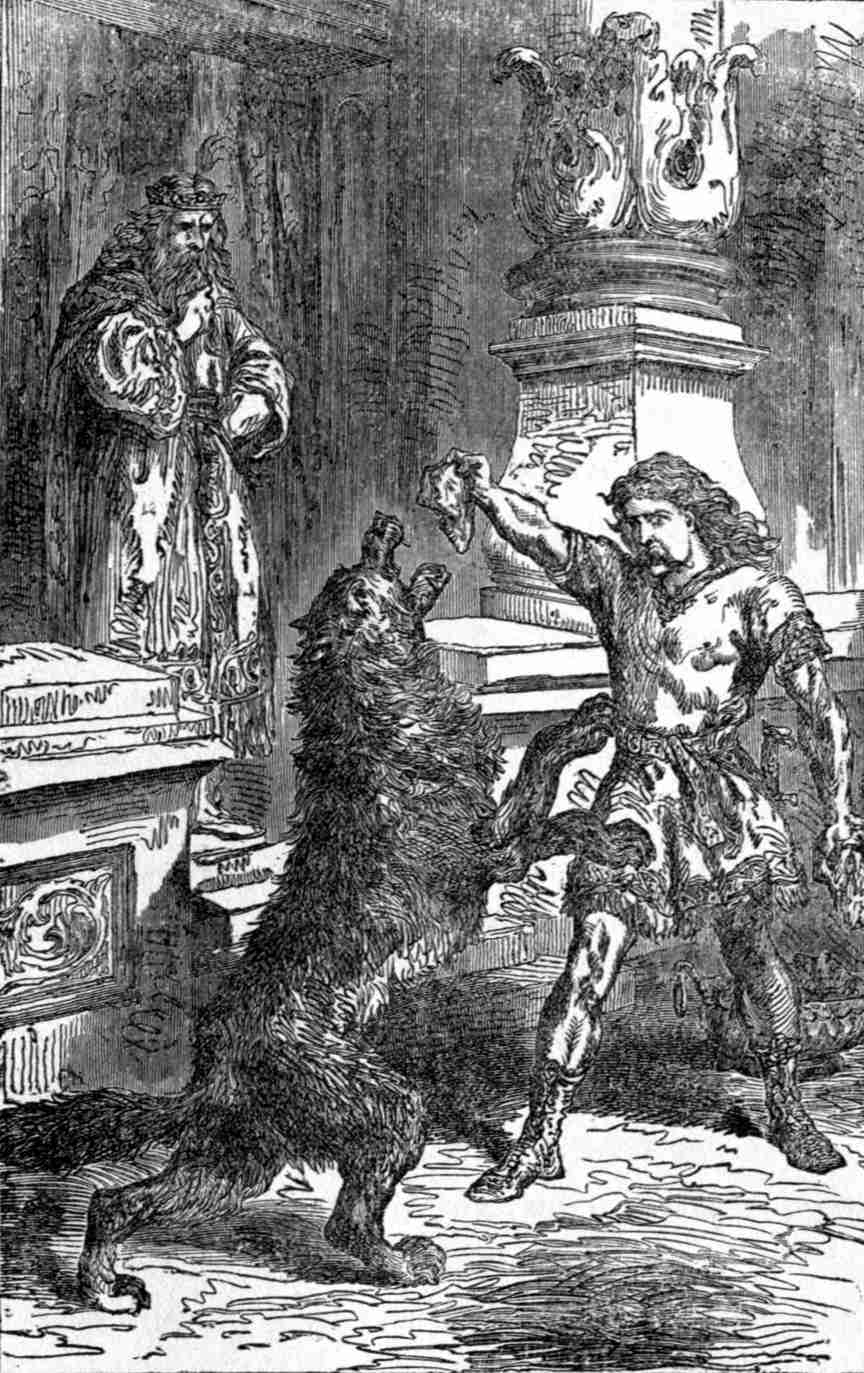
Silence fell across the proud warriors of Asgard. Each looked at his neighbor, and nobody stepped forward. Then Tyr walked out alone, lifted his right arm, and laid his hand upon Fenrir's tongue.
The gods pulled Gleipnir tight. The harder Fenrir thrashed, the deeper the silk bit into his throat, until he saw they had no plan to untie him. The Aesir laughed as he struggled, all except Tyr. Fenrir closed his jaws straight at the wrist and took Tyr's sword hand.
Years later, at the feast in Lokasenna, Loki mocked Tyr before the hall for having one hand and for buying Asgard's safety with broken faith. Tyr answered plainly that though he lacked a hand, the wolf stood bound until Ragnarok. On that day, Tyr would walk out to meet the hound Garmr at Hel's gate and both would fall together.
Iron breaks while silk holds
Two laws sit inside the iron and the silk of Lyngvi island.
First, rigid cages shatter when pressure grows, while invisible ties hold fast. Laeding and Dromi broke on Fenrir's back like dry sticks because they pressed against him from outside. Gleipnir held because it was woven from six subtle threads inside the world itself: breath, roots, sinew and silence.
Second, deceit breaks the standing of the one who tricks, even when the trick succeeds. The Law of One transcripts name the Law of Free Will, or the Law of Confusion, the first law of creation. No power may override consent by fraud without paying for the fracture. As Karen Barad's agential cut makes plain, no maker stands outside the line they draw. Because the Aesir lied to Fenrir, Asgard lived under debt, and Tyr wore the cost of that lie on his wrist.
The rune, the cord and the missing hand
The arrow rune, the silk ribbon and the bare wrist hold one measure.
In the oldest northern script, an upward arrow points due north and carries his name: Tiwaz. Warriors carved that rune on blades for lawful nerve that holds the line when fear breaks rank. North does not drift when the wind changes.
Beside the rune sits the missing right hand. In a warrior's world, the right hand held the blade, the shield oath and the handshake that sealed a pact. Losing it meant Tyr could no longer fight with easy pride. Yet his word inside the Thing became heavier than any blade. Anyone can swear when the cost falls on someone else. Tyr marks the hour when you back a pledge with your own skin.
Look also at Gleipnir's six ingredients. They are not metal walls or louder threats. They are hidden realities beneath noise: footsteps you cannot hear, roots under stone, breath under water. When panic stacks thicker bars over a fear, Gleipnir asks what subtle truth stays unbound.
Where Tyr stands in the sky
Tuesday carries his name from Old English Tiwesdaeg, meaning Tiw's Day, matching Mars's day across the Roman calendar. Birth charts hold no planet named Tyr, yet his current stands out wherever Mars and Saturn lock together.
In traditional books, Mars touching Saturn can look like a brake pressing against a wheel. Through Tyr, that contact marks disciplined nerve that stays at the post long after excitement leaves the room.
Look next at Saturn, Mars or the Sun in Capricorn, Libra and Aries, the signs that govern law, scale and direct action. When a birth time is known, check the seventh house of sworn partners and open rivals beside the tenth house of public standing.
Pairing Tyr with Pluto is a modern addition to northern sky-lore, yet when Saturn or Pluto crosses natal Mars by transit, convenient bargains snap like iron. They ask what you stand behind when comfort walks out.
Stepping inside the Thing ring
Step into Tyr's assembly when a decision demands clear measure. Come when you feel tempted to hide behind vague promises or let someone else pay the cost. Ask him for a straight edge and the nerve to pay your own side of a bargain. He never bought peace cheaply, and he does not bless deceit.
Come on a Tuesday morning in the open air, under a clear sky or cold light.
Stand straight facing north, the direction of the Tiwaz rune. Lay aside keys, pocket knives or anything sharp before stepping to your mark. Men once left steel outside the stones of the Thing.
Hold your right hand open at your side and feel its weight. Name aloud one promise you have been hedging on. Notice where you told someone maybe when the truth asked for yes or no. Speak the plain decision to yourself in direct words, with no excuse attached.
Then inspect where fear has led you to stack iron bars over a problem. Ask what subtle thread like Gleipnir is missing beneath the noise: a clear number, a calm term, a direct talk left unsaid. Write that one term on paper so it cannot drift.
When the term is written down, step two paces back out of the open circle. Lay a pocket knife, key or small piece of iron beside a stone post or threshold stone outside the room, as men laid their blades outside the Thing, and walk indoors with empty hands. Speak one line aloud: what is sworn stands, and I leave the ring in peace.
Questions people ask about Tyr
Who is Tyr in Norse mythology?
Tyr is the Norse god of war law, justice, oaths and the Thing assembly. He descends from Proto-Germanic sky deity Tiwaz. Known as the one-handed god, he placed his right hand in Fenrir's mouth as a pledge of good faith.
Why is Tuesday named after Tyr?
English Tuesday comes from Old English Tiwesdaeg, meaning Tiw's Day, from Proto-Germanic Tiwaz and Old Norse Tyr. When northern peoples adapted the week, they matched Roman Mars's day to Tyr, honored on frontier altars as Mars Thingsus.
Why did Tyr lose his hand to Fenrir?
After Fenrir snapped two iron chains, the dwarves wove the cord Gleipnir from six impossibilities. Suspecting a trap, Fenrir agreed to wear it only if one god laid a hand in his jaws. Only Tyr stepped forward, and Fenrir bit off his hand when the gods refused to untie him.
What is the Tiwaz rune?
Tiwaz is the upward arrow rune named for Tyr in the Elder Futhark alphabet. Carved historically on blades and markers, it stands for lawful courage, northern bearing and truth under trial.
What happens to Tyr at Ragnarok?
In the Prose Edda, Tyr faces Garmr, the hound chained before the cave at Hel's gate, during the final battle. Each slays the other in mutual combat upon the field.
The Tyr archetype
Tyr is the witness at the stone ring, the conscience that backs a spoken word with its own hand.
Your Transits shows when Saturn, Mars and Pluto test your resolve and ask which agreements deserve to stand.