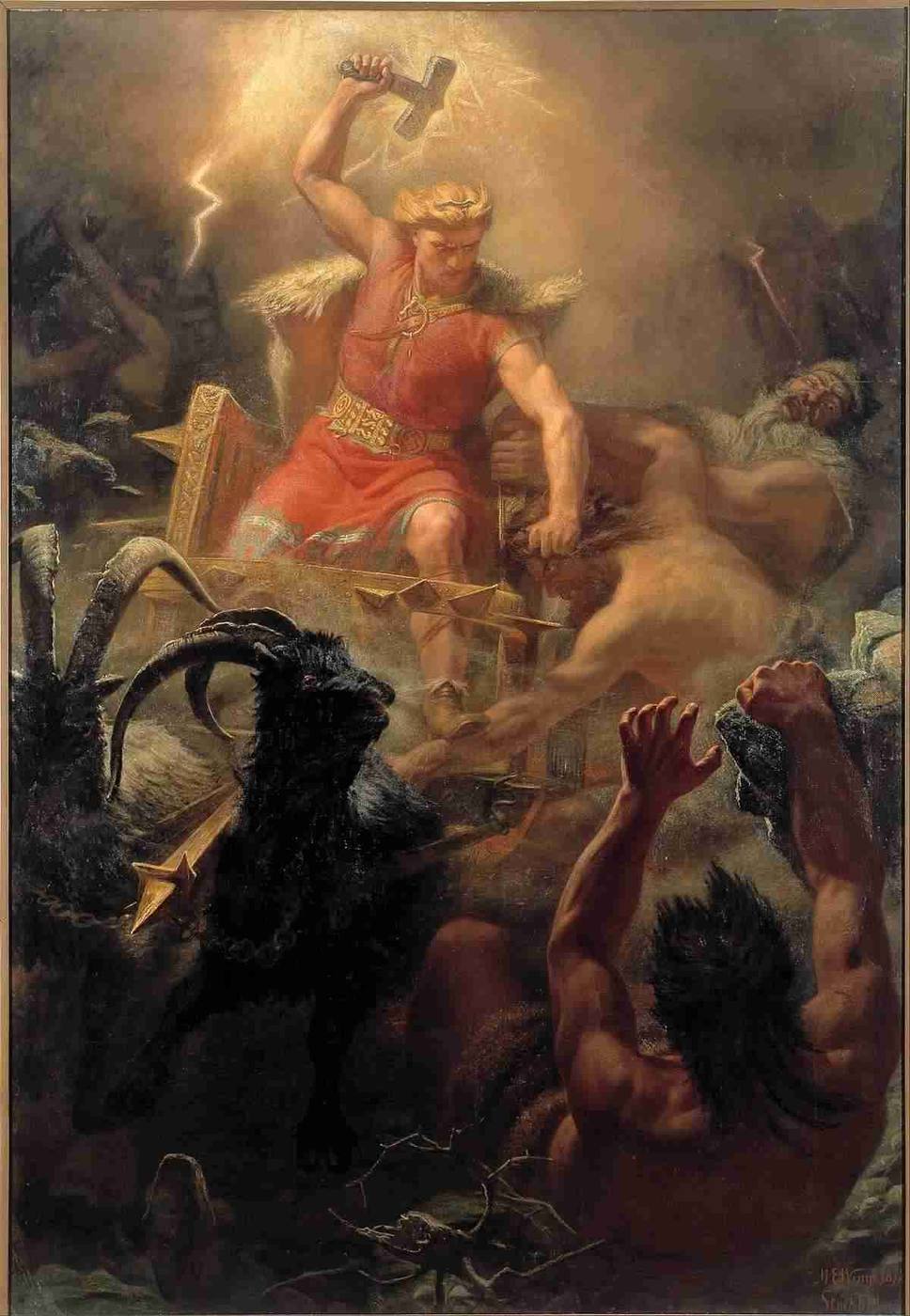
In late summer, heat builds beneath dark clouds until the air grows heavy and still. Then a white bolt crosses the sky, strikes the earth, and breaks the stillness with rain.
That stroke between heaven and ground is Thor.
Thor is the Norse god of thunder, storms, oaks and protection, son of Odin and Earth goddess Jord, husband of golden-haired Sif, and defender of Asgard and Midgard. His Old Norse name means Thunder, and farmers, builders and sailors wore small hammers of iron and silver for safety along every coast. He is a consciousness, older than the halls of kings. And the North left a technology for meeting him. His hammer, his iron gloves, his belt and his goats were parts of that instrument.
The circuit of sky and earth
Odin walks the wind for hidden knowledge. Thor walks the muddy roads to keep the roof over Midgard standing.
His mother is Jord, Earth herself. Because his root lies in soil and stone, Thor's strength moves through real weather and physical structure. Lightning is not merely a display high in the clouds. It is an electrical discharge closing a gap between sky and earth so charged air can balance again.
In their message Gaia's Song, Tom Kenyon and the Hathors describe Earth as a conscious being whose intelligence dwarfs human thought. When an energetic system shifts into a new state, they warn, Chaotic Nodes appear across the planet as storms, solar surges and quakes. Yet your own body is a standing wave of light and matter forged from Earth's elements. Lee Carroll says much the same in a Kryon talk from Delphi University. Earth knows humanity as an old partner, and ancient peoples stayed strong because their feet stayed close to the soil.
That is Thor. He grounds storm energy into the earth and stands between human life and disorder.
The hall of illusions and the goats
Two stories in the Prose Edda show both the reach of Thor's strength and the edge where muscle stops.
Thor drove his chariot across the worlds behind two goats, Tanngrisnir and Tanngnjostr. At nightfall he stopped at a farm, slaughtered both goats, roasted the meat, and shared the meal with the household. He spread the hides beside the hearth. He told everyone to throw the bones onto the skins without breaking a single bone.
A farmer's son named Thjalfi grew greedy for marrow. With his knife he split one thighbone open. At dawn Thor rose and swung his hammer Mjolnir over the hides to hallow the bones. Both goats leaped to their feet alive, yet one limped from a broken leg.
In a second story, Thor traveled to the fortress of the giant king Utgarda-Loki. Mocked inside the giant's hall, Thor accepted three tests of strength.
First they brought him a drinking horn. Thor drank three huge pulls until his breath gave out, yet the horn still held drink. Next they set a grey cat on the floor and asked him to lift it. Thor strained until his muscles shook. He managed only to raise one paw off the stone. At last Utgarda-Loki called out a toothless crone named Elli to wrestle him. The harder Thor gripped her, the tighter she held, until she forced the thunder god onto one knee.
Outside the gates next morning, Utgarda-Loki told the truth. The horn's far end lay in the sea, and Thor's swallows had dropped the tide. The cat was Jormungandr, the World Serpent coiled round the earth. Elli was Old Age itself, whom no arm in heaven or earth can defeat.
Whole bones and the turn of the seasons
Set side by side, those two tales reveal two laws of power and matter.
First, strength only renews when the frame of life stays whole. Thor could call his goats back from death morning after morning, so long as the bones remained intact on the hide. When Thjalfi cracked one bone for extra marrow tonight, tomorrow's stride went lame. A body, a craft or a household can carry heavy labor every day, provided its core structure is not broken for a short gain.
Second, no single strike outlasts the turn of the years. A bolt of lightning splits a great oak in one bright instant, yet winter frost, sea tides and slow rust still wear down iron and stone alike. Thor could shatter mountain giants with one blow. Yet even thunder bends one knee to Elli, because no muscle can arm-wrestle the sea or hold back the passing of seasons.
The hammer, the gloves and the belt
Iron, leather and ash wood hold Thor's strength together.
Begin with Mjolnir, forged by the dwarves Brokkr and Sindri. As Brokkr worked the bellows, Loki took the shape of a gadfly and bit the dwarf's eyelid until blood blinded him for a moment. Because of that pause, Mjolnir came out with a short handle. A short handle leaves no room to strike from afar. Whoever swings Mjolnir must step close, grip with both hands, and stay inside the reach of what they hit.
And Mjolnir is far more than a weapon. Across the Eddas, Thor lifts the hammer to bless marriages, hallow funeral pyres and bring his goats back to life. In his hand, power clears chaos so living bonds can hold.
Around his waist sits Megingjord, the belt that doubles his strength by containing it at the center. On his hands sit Jarngreipr, iron gauntlets needed to hold Mjolnir's blazing shaft without burning the flesh. Lightning needs insulation and containment, or it scorches the hand that tries to wield it.
Where Thor strikes in the sky
Thursday carries his name in Old English Thunresdaeg and Old Norse Thorsdagr, matching dies Iovis, the day of Jupiter across the Roman week. Astronomers later named belt asteroid 299 Thora, while matching Thor to Pluto or modern planetary cycles is a modern step beyond Old Norse sky-lore.
Begin with Jupiter, which mirrors Thor's generosity, open table and storm-clearing scale. Look at Jupiter's sign and house to see where protection grows stronger when shared with others.
Watch next where Mars and Saturn meet. Mars brings the strike of lightning and the nerve to stand in the eastern pass. Saturn supplies the iron gauntlets, the belt of containment and the short handle of Mjolnir, teaching patience before Elli and respect for time.
Look also at contacts from Pluto to the Sun or Mars. Those hard angles show where fierce protective drive must stay anchored in the humility of Jord instead of turning rigid.
Calling Thor where the oak meets the storm
Call on Thor when stagnant heat, fear or disorder gathers around your home and you need grounded strength to clear the air. Bring him real work that needs hands and shelter, like a mended latch or a firm watch over your household. Remember Utgarda-Loki's hall, where boastful strength met its match before dusk.
Come on a Thursday, or before hard physical labor.
Stand barefoot on soil, grass or stone, or lay one hand on an iron tool or a solid wooden beam. Feel your feet pressed into Jord, the earth beneath you.
Name aloud one real gap in your perimeter that needs tending today. A broken latch, an unkept promise or a task left undone in the house. Pick one concrete thing you can finish with your own hands, remembering Mjolnir's short handle.
Breathe deep into the belly, where Megingjord sits around the waist. Exhale with force through the mouth once or twice, like thunder breaking the heavy air, and let nervous heat drop down through your heels into the ground.
Check your bones, like the goats' hides at evening. Ask where you have been cracking tomorrow's rest just to squeeze extra speed out of tonight.
When the work is finished, set your iron tool or belt buckle down on a stone sill or wooden bench outside your sleeping room. Step inside, eat a warm meal with any bone left unbroken on the plate, and share bread if someone sits at your table. Speak one line aloud: the work of today holds, and the storm passes out of the house into the damp earth until morning.
Questions people ask about Thor
Who is Thor in Norse mythology?
Thor is the Norse god of thunder, storms, oaks, protection and hallowing, son of Odin and Earth goddess Jord, husband of Sif and defender of Asgard and Midgard. Farmers, sailors and builders revered him closely and wore small hammers for safety.
Why is Thursday named after Thor?
Thursday comes from Old English Thunresdaeg and Old Norse Thorsdagr, meaning Thor's Day. Germanic speakers matched Jupiter's day, dies Iovis, with their thunder god Thor, linking both to storms, protection and sky law.
Why does Mjolnir have a short handle?
While the dwarves Brokkr and Sindri forged Mjolnir, Loki turned into a gadfly and bit Brokkr on the eyelid, interrupting the bellows for an instant. That flaw shortened the shaft, forcing Thor to step close and hold the hammer with iron gloves.
Why could Thor not defeat Elli in Utgarda-Loki's hall?
Utgarda-Loki tricked Thor into wrestling Elli, who was Old Age itself, while lifting a cat that was the World Serpent and drinking from a horn tied to the sea. No physical strength can overcome time, ocean and planetary scale.
What happens to Thor at Ragnarok?
At Ragnarok on Vigrid's plain, Thor fights Jormungandr, the World Serpent encircling the earth. He kills the serpent with Mjolnir, walks nine steps, and falls from its venom, leaving Mjolnir to his sons Modi and Magni in the renewed world.
The Thor archetype
Thor is the earth-rooted protector, the thunderbolt that clears stagnant air and hallows the ground where life stands.
Your Transits tracks when Jupiter, Mars and Saturn stir pressure in your chart and where grounded action holds the line.