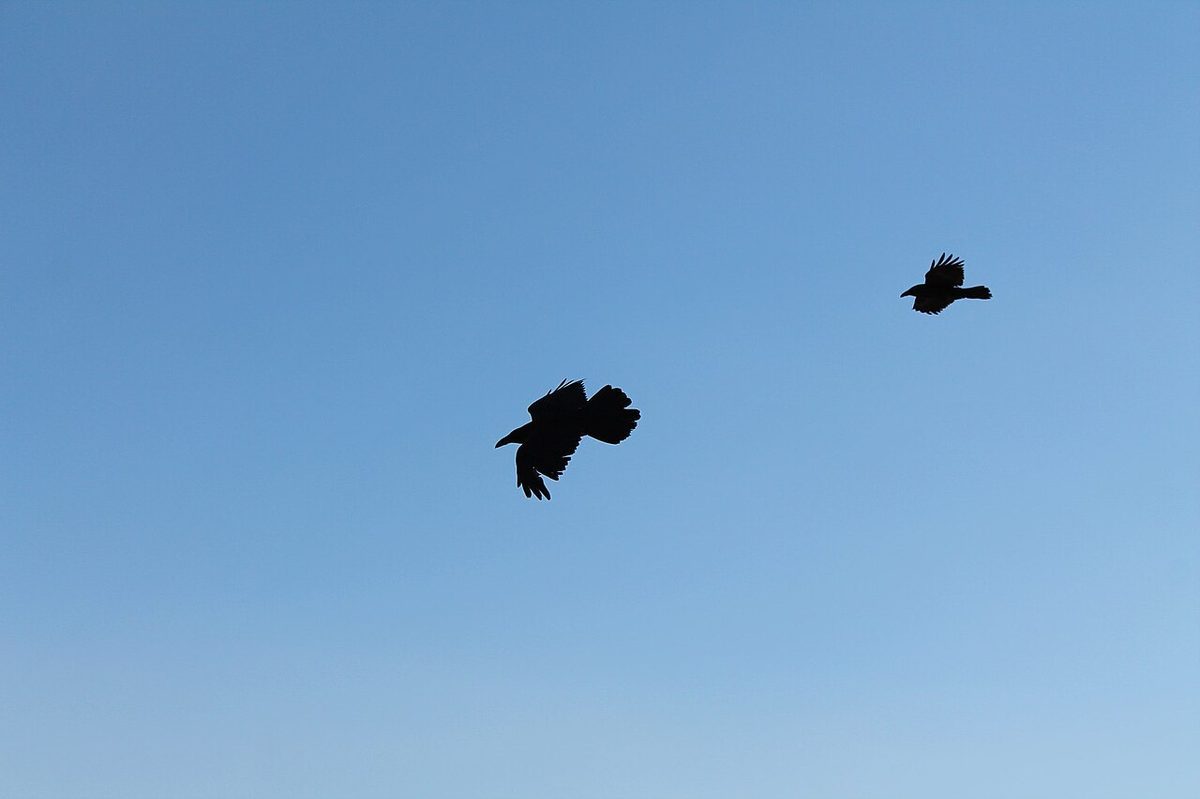
Dusk settles over a river ford in late autumn. Water runs dark between stones, and mist hangs low above the rushes where cattle cross. A shadow drops onto a bare branch overhead and watches the bank without blinking.
This is the watch of the Morrigan.
The Morrigan is the Irish goddess whose name means Great Queen or Phantom Queen, appearing in triad beside Badb, Macha and Nemain. She stands over battlefields, kingship, prophecy and the crossings where an old order falls. She is a living consciousness that tests rulers at the river, speaks the outcome before swords lift, and counts every cost until nothing hides. Her raven wings, her shifting shapes and her chant at the water form a technology for seeing consequence straight in the face.
The bird that watches across time
Most minds live trapped inside one second, staring at the gravel at their feet. Ravens carry a wider map.
In The Matter With Things, Iain McGilchrist cites research by Can Kabadayi and Mathias Osvath showing that ravens plan flexibly across time for tool use and bartering. Corvids hold mental maps of future turns before the moment arrives, even teaching their young how to use tools.
In his essay Synchronicities, Tom Kenyon tells a personal story about crows. One night around twilight, he sat in doubt, wondering if a spirit contact was real or invented. Suddenly dozens of crows landed on his roof and bounced up and down on the tiles. That commotion broke through his skepticism at once, acting as a blunt messenger from beyond habit.
The Morrigan carries that bird sight to the river crossing, watching what you are about to build before your hand lifts a stone.
The river crossing and the three wounds
These stories come from the Second Battle of Mag Tuired, the Cattle Raid of Cooley and the Death of Cu Chulainn.
At Samhain, before war began between the Tuatha De Danann and the Fomorians, the Dagda walked to the River Unius in Connacht. There he found the Morrigan standing astride the stream with one foot on each bank, washing. They joined in alliance by the river. She promised to strip the Fomorian king Indech of his blood and strength. When battle ended, she chanted prophecy of the victory and the ages waiting ahead.
Years later, she offered the same backing to Cu Chulainn, the hero of Ulster, during the Cattle Raid of Cooley. She walked up to him dressed in red, bringing cattle, alliance and strength. Cu Chulainn mocked her and answered that he came to fight men. He left no room for a woman's help.
She warned him that she would meet him in the river ford while he fought his hardest foe. When combat began at the water, the Morrigan rose against him in three shapes. First she coiled around his ankles as an eel and tripped him. He crushed her ribs against a stone. Next she drove cattle across the water as a grey wolf. He struck out one of her eyes with his sling. Last she led the stampeding herd as a red heifer, and he shattered her leg with a cast.
Later, worn down by battle, Cu Chulainn passed an old woman sitting beside the road, milking a cow with three teats. She bore the three wounds he had given her at the ford. Thirsty and unaware of who she was, he begged for milk. She gave him one sip from the first teat and he blessed her eye, which healed. He drank a second sip and blessed her ribs, and then a third sip and blessed her leg.
Even after those blessings, the refused pact stayed on the ledger. On Cu Chulainn's final battle day, wounded and bound upright to a stone pillar, he fought until the breath left his chest. Only when his life had gone out did a black crow land upon his shoulder to witness the end.
What meets the ankle at the ford
Look beneath the blood and the shapeshifting. Two plain laws govern the river ford.
First, power that insults the ground beneath its boots trips at the crossing. The Dagda met the Morrigan at the water and made alliance with the land itself. Cu Chulainn boasted of solo strength and dismissed her at the gate. Any person who fights without respect for the roots, seasons and waters holding them up finds the river rising against their ankles.
Second, what you refuse to look at becomes a phantom until you meet its eyes. In his Kryon talk Akashic Evolution, Lee Carroll speaks to this. He describes old battlefield memories returning in dreams or sudden discomfort so we look them straight in the face. In that act of direct looking, he says, phantom karma clears and loses its grip.
Anne Tucker speaks of this same turn in Road Sign and We Changed, Now the World Changes. Letting go of old grudges and inner resistance drops the invisible battlefield inside the chest. Once that war stops, perception sharpens and inner authority returns. What looked like an enemy on the road turns out to be a messenger holding a cup of milk.
Wing, ford, three sips and war-cry
Each mark around the Morrigan cuts through denial.
The black crow or raven arrives only after battle ends, yet it watches from high branches long before the first blow lands. It stands for memory, foresight and a witness that refuses to look away from decay or change.
The river ford, where Irish lore sets the Washer at the Ford rinsing stained armor before a fight, is neither dry land nor deep sea. It is the ankle-deep crossing where an old identity steps off one bank before reaching the next.
Her three shapes, eel, wolf and heifer, bring water, wild hunt and herd forward whenever pride pretends to rule alone.
From the old woman's wooden bowl come the three sips of milk. Blessing the wounded witness undoes old hardness, even when outer fate still runs its course.
At Mag Tuired rings her prophetic chant. Speaking the truth of an ending out loud clears the fog from the field so the living can step into what comes next.
Where the Morrigan marks a chart
In the seasonal wheel, the Morrigan rules Samhain at the end of October, midway between the autumn equinox and the winter solstice. The Sun moves near fifteen degrees of Scorpio, the fixed water sign of depth, shedding and reckoning. Leaves rot back into black soil so next spring has food.
Early Irish lore watched the turning sun, the dark half of the year and Samhain itself, while linking the Morrigan to Pluto and Black Moon Lilith is a modern astrological step. In a birth chart, her stamp falls on Pluto, Mars and Saturn across the eighth and twelfth houses. Mars brings heat, courage and the test of battle. Pluto governs deep endings, hidden reserves and truth stripped of polite masks. Saturn weighs every pact against time and consequence.
Look also at Black Moon Lilith. Where Lilith sits, a chart holds a refusal to bow to false terms. That spot also marks where an uninvited witness waits at the crossing until you hear her voice.
Standing the watch at the river ford
Call on the Morrigan when a chapter demands truth, when you dodge a choice, or when anger keeps replaying an inner war. Come only when you mean to keep your word to the land and to yourself. Meet her at dusk, beside moving water if possible, or at a table with a wooden cup of stream or well water.
Stand straight for three breaths with your feet apart, as if checking your footing on stones in a stream. Look out across the whole horizon of the room or skyline instead of staring at one stone at your feet.
Name aloud one crossing you have put off, or one truth you refused to face. Do not dress it up with excuses. Speak it once, like a witness writing down a fact in daylight. Then take one sip from the cup. Ask what alliance you owe to the ground, your body or the people around you before moving ahead.
When the watch ends, step back off the river stones onto the dry grass of the bank, or step away from the table. Pour the remaining water onto bare soil outside your door as an offering to the land, set the empty cup upside down, and walk away without looking back over your shoulder.
Questions people ask about the Morrigan
What does the name Morrigan mean?
Scholars trace Morrigan to Irish roots meaning Great Queen or Phantom Queen. In early tales she is tied to kingship, war-omen, prophecy and the living land of Ireland.
Who are Badb, Macha and Nemain beside the Morrigan?
In Irish lore, the Morrigan often appears as a triad of sisters with Badb, Macha and Nemain. Badb takes the shape of a scald-crow on the field. Macha and Nemain bring speed, frenzy and dread to battle.
Why did the Morrigan turn against Cu Chulainn at the ford?
On the eve of battle, she appeared to Cu Chulainn in red and offered alliance and aid. Because he mocked her and refused a woman's backing, she opposed him in the river ford as an eel, a wolf and a heifer.
What does the raven or crow represent in her stories?
The raven or crow marks foresight, prophecy and unblinking witness. Just as corvids watch the whole horizon and plan ahead, the bird witnesses endings without flinching.
Which planets reflect the Morrigan in a birth chart?
The Morrigan mirrors Pluto, Mars, Saturn and Black Moon Lilith, especially through Scorpio and the eighth and twelfth houses. Those placements mark deep thresholds, hard reckonings and the courage to face the truth directly.
The witness at the water
The Morrigan is the unblinking eye at the river ford, asking every traveler to meet consequence face to face before crossing.