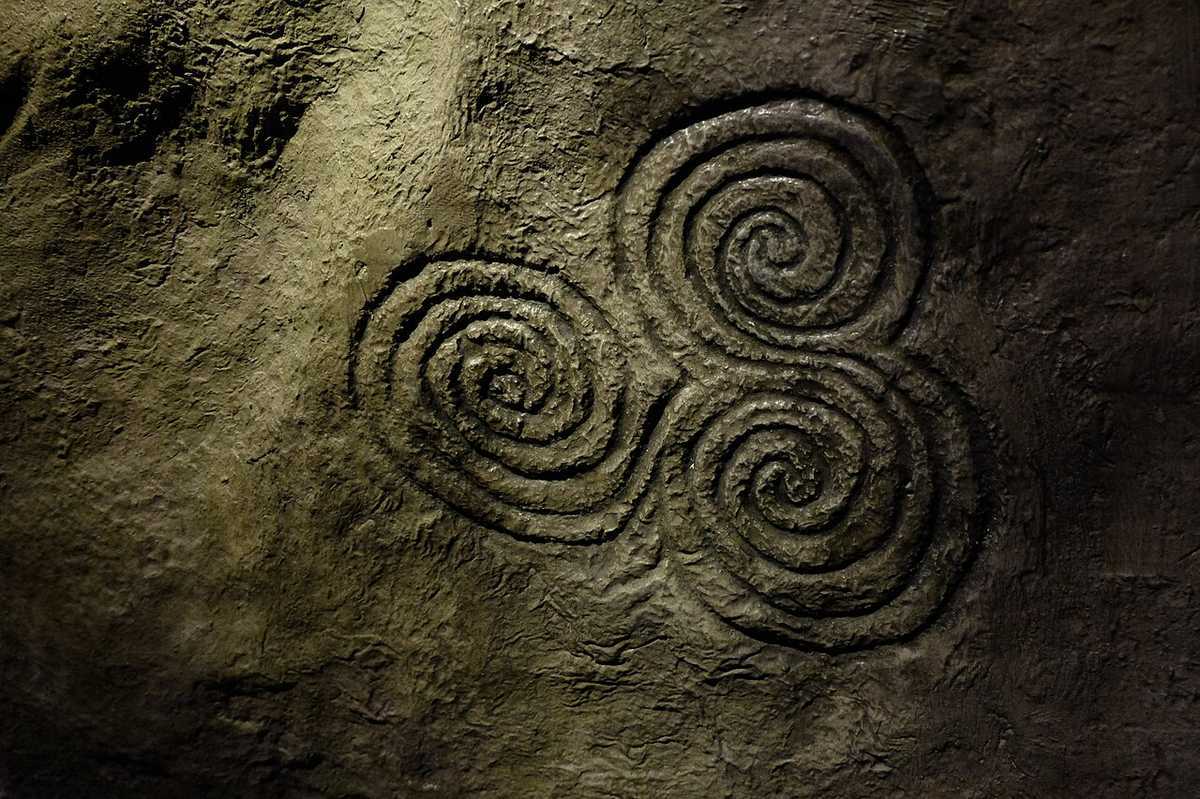
Deep inside the mound at Newgrange, a stone passage lies in darkness through the longest night of the year. Above the doorway waits a narrow slit in the roof. At the winter solstice, a beam of sunlight slips through that opening, walks down the floor, and touches a triple spiral carved into stone five thousand years ago.
That spiral holds three Celtic figures together.
Lugh, Rhiannon and Cerridwen come from Irish and Welsh lore as three faces of one unfolding intelligence. Lugh is the many-skilled master at Tara's gate. Rhiannon is the queen on a pale mare in the Mabinogion. Cerridwen is the keeper of the cauldron of inspiration in the tale of Taliesin. Together they form a living current across craft, poise and rebirth, and their emblems work like an instrument for turning raw effort into light.
From the frog's well to the quantum leap
Most people picture growth as a straight ladder. You climb one rung at a time until you reach the top. Living skill moves in spirals instead.
In The Quantum Brain, Amit Goswami tells a story about how mastery works. Practice builds ability step by step until effort relaxes and the player drops into flow. Then discovery arrives all at once as a discontinuous leap, like an electron jumping between orbits without crossing the space between. Goswami pairs this with an old tale of a swan landing beside a well. A frog inside the stone walls tries to measure the sea by jumping from wall to wall, unable to picture anything wider than its own ring.
Lugh, Rhiannon and Cerridwen break open that well. One masters every art until effort relaxes. One refuses frantic chasing. One boils the whole frame down until a new singer steps out.
Three turns of the Celtic story
These tales come from the Second Battle of Mag Tuired, the Welsh Mabinogion and the Hanes Taliesin.
First came Lugh, called Long-Arm and Samildanach, meaning equally skilled in all arts. He walked up to the locked gates of Tara, where King Nuada held court inside. The doorkeeper blocked his path and asked what single craft he practiced, since no one entered the hall without one art to serve the king.
Lugh named himself a carpenter, and the keeper said they had one already. Lugh named smith, champion, harpist, poet, historian, sorcerer and cupbearer, one after another. Each time the gate stayed shut. At last Lugh asked the keeper to inquire inside whether any warrior in the hall possessed all those arts together. No one did, so the bolts drew back and Lugh took the sage's seat. Later he founded the harvest games of Lughnasadh to honor his foster-mother Tailtiu, who cleared the plains for grain before she died.
Second came Rhiannon, riding past the mound of Narberth in Wales. King Pwyll saw her dressed in gold silk upon a pale mare that moved at an easy amble. He sent his swiftest horsemen after her. Every rider spurred his mount to a full gallop, yet Rhiannon never seemed to hurry and always stayed ahead.
On the fourth day Pwyll chased her himself until his horse blew hard. At last he called out and asked her politely to stop. Rhiannon reined in at once. She told him it would have been better for his horse if he had asked sooner. Later, after they wed and bore a boy named Pryderi, servants fell asleep and lost the child. They smeared blood on Rhiannon to hide their fault. She accepted the false sentence and sat by the horse-block at the gate for years. Her three birds sang melodies so sweet that listeners forgot time until her son came home and truth surfaced.
Third came Cerridwen beside Lake Bala in Wales. She set a cauldron of Awen, or poetic inspiration, to boil for a year and a day for her son Afagddu. She hired a boy named Gwion Bach to stir the fire. Near the end of the year, three drops of boiling liquid flew out and landed on Gwion's thumb. He thrust his burned thumb into his mouth and received the knowledge meant for her son.
Cerridwen chased him in fury across land, water and sky. Gwion turned into a hare, and she became a greyhound. He leaped into a river as a salmon, and she dove as an otter. He rose as a bird, and she stooped as a hawk. Dropping onto a barn floor as a grain of wheat, Gwion was swallowed by Cerridwen in the shape of a black hen. Nine months later she bore him from her womb, sewed him into a leather bag, and cast him into a salmon weir. A prince pulled the bag out on May Eve and opened it to find a boy with a shining brow, whom he named Taliesin.
Ease on the hill and patience at the cauldron
Look at the three tales laid side by side. Two clear laws link them to the spiral on the stone at Newgrange.
First, what is chased by panic runs forever out of reach. Pwyll's horsemen wore out their mounts chasing Rhiannon, and she stopped only when Pwyll spoke with courtesy and ease. Tom Kenyon and the Hathors describe this rule in The Trillium Sound Meditation. Earth stands inside an immense metamorphosis, Kenyon writes, where subtle power answers ease and open intention instead of strain. Trying too hard locks the mind like a fist, keeping the leap out of reach.
Second, what stays at its true pace until the year and a day are full boils into light. Anne Tucker teaches this in The Energies of 2025. She says old heaviness must broil inside the cauldron of discomfort so hidden truth rises and clears. Never force the lid off early.
Maia Nartoomid adds a star-lore thread from Thoth in her writings on the Halls of Records and Mazzaroth. She describes the Tuatha De Danann as a lineage crossing time who guarded the full cauldron and recorded sky cycles in Ogham script. Craft, poise and heat all belong to one long count.
Spear, mare, cauldron and grain
The spear, the pale mare and the black cauldron each hold one turn of the spiral.
Lugh carries a spear and a grip on many trades. Mastery does not come from hoarding one narrow trick inside a dark well. Gathering diverse skills trains the mind to spot distant links, relax into flow and strike true when the moment opens.
Rhiannon rides a pale mare beside her three singing birds. Her pace never jumps when others panic. Her birds carry a sound that settles grief and sleepiness so people wait long enough for buried truth to walk back through the door.
Cerridwen tends a cauldron above a slow fire, right down to a single grain of wheat. Nothing in the chase goes to waste. Every disguise Gwion wears teaches him earth, water and air before the grain dies inside the hen and rises as Taliesin, the singer with the radiant brow.
The three figures in the turning sky
In the seasonal wheel, these three stories bridge the winter solstice and high summer. Newgrange catches the solstice beam in early Capricorn, when the light turns back toward growth inside the dark. Lughnasadh arrives in mid-Leo around the start of August, marking the first cut of wheat.
Older Celtic lore watched the sun, the moon and the turning seasons, while matching these myths to outer planets like Neptune and Pluto is a modern step. In a birth chart, Lugh shines through the Sun and Mercury. The Sun marks radiant skill and leadership at the center of the hall, while Mercury links carpenter, poet and harpist into one quick mind.
Rhiannon mirrors the Moon, Venus and Saturn together. Venus and the Moon govern the horse, the song and the long grace, while Saturn holds the horse-block at the gate, refusing to move until time clears false blame.
Cerridwen belongs to Pluto and Neptune. Pluto stirs the heat beneath the cauldron that strips every mask away, while Neptune dissolves an old form so a new song rises out of the weir.
Meeting the three at the cauldron and the gate
Call on these three when craft stalls, when panic tempts you to chase what pulls away, or when work feels stuck inside heavy heat. Meet them at dawn or at dusk beside a wooden table or hearth.
Set a covered bowl or small pot beside a dry oatcake. Sit upright and name which turn of the spiral stands before you today. Are you gathering skills like Lugh, waiting at the gate like Rhiannon, or enduring heat like Gwion?
Take five breaths and let strain drop from your shoulders. Following Goswami and Kenyon, stop pushing the answer with force. Hold your question lightly, like watching a swan land beside a well, ready for a wider view than habit knows.
If frustration flares, wait as Rhiannon waited instead of spurring the horse. Speak your intent once without haste. Let the heat stay under the pot until the work ripens in its season.
When the watch is done, set a lid firmly over the pot or bowl so the brew keeps its heat. Eat the oatcake whole, brush the crumbs off the wood, and step out of the room so the cauldron simmers untouched until morning.
Questions people ask about Lugh, Rhiannon and Cerridwen
Why does Lugh carry the title Samildanach?
Samildanach means equally skilled in all arts. Lugh earned the title at the gates of Tara by proving he held every craft of the hall together instead of practicing only one trade.
Why could no rider catch Rhiannon on her pale horse?
Rhiannon moved at a magical pace that mocked frantic pursuit. No rider could overtake her until King Pwyll stopped chasing and asked politely for her to wait.
What happened inside Cerridwen's cauldron of inspiration?
Cerridwen boiled the herbs of Awen for a year and a day to brew wisdom. Three hot drops spilled onto young Gwion Bach, leading to a shape-shifting chase and his rebirth as the poet Taliesin.
How does the triple spiral at Newgrange tie these three together?
The three linked spirals carved inside Newgrange mirror a single cycle of skill, poise and transformation. Light enters the stone chamber once a year, just as illumination enters after patient work and surrender.
How do Lugh, Rhiannon and Cerridwen show up in an astrology chart?
Lugh connects to the Sun and Mercury through craft and mastery. Rhiannon echoes the Moon, Venus and Saturn's patience, while Cerridwen reflects Pluto and Neptune's cycles of dissolution and rebirth.
The three turns of one light
Lugh builds the skill, Rhiannon holds the pace, and Cerridwen brews the passage until song breaks through the shell.