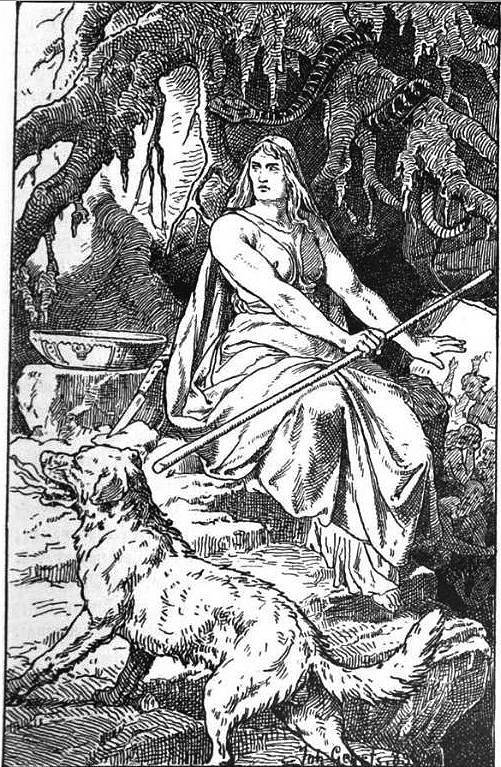
Far north of the bright halls, cold rivers run downward into mist until stone walls rise out of the fog. No torch burns inside those gates to flatter kings or scare children.
The queen who rules that mist-home is Hel.
Hel is the Norse queen of the underworld called Helheim, daughter of Loki and the giantess Angrboda. Her name means the Hidden One or Covered One. Centuries later, English borrowed her name for fiery torment, yet in the old northern books her realm holds no flames. Older than fear of the dark, she left her law in three plain signs: her two-toned skin, the echoing bridge and the bare table of her hall.
Across the river that asks no favors
Most people treat an ending as an accident or a defeat. They try to argue with the gate or bribe the ferryman. Hel does not argue, and she takes no bribe.
Physics knows a border that behaves in the same firm way. In A Brief History of Time, Stephen Hawking writes about the event horizon of a black hole. It is a one-way membrane in space and time. Objects and light can cross inward through that border, yet no signal can climb back out to tell an outside watcher what lies inside. Even so, the laws of nature do not vanish behind the rim.
Consciousness teachers map that crossing from the inside. In Physics of the Soul, Amit Goswami reads the Tibetan Book of the Dead beside quantum nonlocality. He reminds readers that the Tibetan word bardo means transition, not a torture pit. Life and death form a continuous loop of passageways. At the moment of crossing, the outer costume drops away and awareness meets clear consciousness outside ordinary time.
Hel sits at that exact one-way border. She keeps the cold stillness of what has finished so nothing false tries to sneak back into yesterday.
The hall in the mist and the weeping test
This is the story told in the Prose Edda of Snorri Sturluson and remembered in Baldrs draumar.
When Loki fathered three strange children in Jotunheim with Angrboda, Odin saw trouble ahead. He cast the serpent into the sea, kept the wolf inside Asgard, and threw the daughter Hel straight down into Niflheim, the world of mist. There he gave her rule over all nine worlds, to house every soul who died of sickness or old age instead of falling by the sword.
In Helheim she built high fences and barred gates called Helgrind. Her hall was named Eljudnir, meaning Sleet-Damp. Inside stood her dish Hunger, her knife Famine, her bed Sickbed and her threshold Stumbling-Precipice. Her servants moved at a slow pace, and her curtains hung pale and cold.
Yet when radiant Baldr fell to the mistletoe dart, he rode down the dark road for nine nights and entered Hel's hall. She did not chain him or mock him. She sat Baldr in the seat of honor beside his wife Nanna and poured mead for his table.
Odin sent his messenger Hermodr upon eight-legged Sleipnir to ride after Baldr and beg for his return. For nine nights Hermodr rode through deep valleys so dark he saw nothing, until he reached the river Gjoll and the golden-thatched bridge Gjallarbru.
A maiden named Modgudr guarded the bridge. She stopped the rider and spoke in wonder, saying five troops of dead men had crossed the day before, yet Gjallarbru echoed louder under Hermodr's single horse than under all those hosts. She pointed him downward and north toward Hel's fence.
Sleipnir leaped high over Helgrind's barred gate without touching wood. Hermodr found Baldr in the high seat, stayed the night, and pleaded with Hel at morning to let Baldr ride home because every world wept for him.
Hel listened without flattery and without spite. She set one plain condition. If all things in the worlds, both living and dead, would weep for Baldr, he could walk back to Asgard. If a single thing spoke against him or kept dry eyes, he would stay with her.
Messengers rode across earth and sky. Trees wept, stones wept, iron and soil wept like frost thawing in a warm room. Then the riders found an old giantess named Thokk sitting inside a dark cave. She refused to weep, saying Hel could keep what she held. Because one voice stayed dry, Baldr remained inside Hel's mist until the end of the age, when a new earth rises out of the sea.
Why the gate opens only one way
Two laws of passage sit inside Hel's silent hall.
First, when outer signals vanish, awareness enters a clear review space where nothing can be faked. In Transition States into New Realities, Tom Kenyon and the Hathors describe physical death as a moment when all five sensory markers suddenly fall away. Without clocks, walls or voices to lean on, consciousness stands inside a silent void point. Kenyon also writes in his essay Death and Dying about his Tibetan teacher Yabsang Rinpoche crossing the forty-day bardo of death while still aiding students through direct mind.
Second, a completed cycle cannot be undone by bargaining, only accepted in full. Session 71 of The Law of One contrasts physical space-time with the fluid realm of time-space entered after death. Inside space-time, a person works in dim light and can change course through action. Inside time-space, unbalanced deeds can no longer be reversed by quick tricks. A soul sees the whole life clearly, forgives itself, and sets the pattern for what comes next. That is why Hel refuses Odin's plea for special favors. She asks for total grief from every stone and root, because partial surrender leaves a cycle half-finished.
Half flesh, half shadow and the stark house
Hel's body and her house tell the same plain truth.
Snorri describes her body plainly: half ordinary warm flesh, and half blue-black corpse skin called bla. She holds growth and decay inside one frame. Nothing living escapes ending, and nothing dead stands outside the whole.
Look next at Gjallarbru, the resounding bridge over Gjoll. Why did it thunder under one living horse while dead crowds passed softly? Living weight still carries unfinished urgency and noise. When a chapter truly ends, weight leaves the floorboards and the crossing turns light.
Look third at her stark furnishings: Hunger, Famine, Sickbed and Stumbling-Precipice. Far from cruelty, these names strip every sweet cover off mortal limits. Hel names what ends so awareness stops wasting strength pretending winter will never come.
Where Hel marks the sky
In a modern birth chart, Hel speaks through Saturn, Pluto and the South Node of the Moon. Pairing her with Pluto is a modern lens, since that distant world was discovered in 1930, long after Old Norse tradition.
Saturn marks bone, time, age and the hard fence around what cannot stretch forever. Pluto governs the deep root beneath the floor, where one form sheds its skin before another can sprout. The South Node shows the road already walked, the habits and debts ready to be laid down at the gate.
Look closely at the eighth and twelfth houses when a birth time is known. Those rooms hold shared endings, deep retreat and the mist between one chapter and the next. When Saturn or Pluto crosses your natal Sun, Moon or South Node, a season closes its door like Helgrind snapping shut. Fighting the latch wastes heat. Greeting the threshold lets the next cycle clear its ground.
Standing before the frost gate
Stand at Hel's gate when a long chapter in your life, work or identity has clearly ended and you keep knocking on the locked wood to get it back. Come for spiritual clarity around closure, never for medical help or easy rescue. She offers stillness and plain truth, never false hope.
Wait for dusk or cool evening air when noise settles along the street.
Place one dark river stone and an empty wooden bowl side by side on a table. Sit upright on a low wooden cushion with your palms turned down on your thighs. Look down at your own two hands. Notice the warm pulse inside your wrists beside the stillness of the stone. Remember Hel's two-toned face, holding life and ending in one frame.
Name aloud one finished season, role or attachment that you have been trying to bargain back into life, like Hermodr riding after Baldr. Speak it clearly to the room: this chapter has crossed Gjallarbru, and I stop chasing it backward.
Sit still for two full minutes inside the silence after your voice stops. Let the void point stay empty without rushing to fill it with new plans.
Do not linger inside the mist once the door has shut.
Rise from your chair, turn the empty bowl upside down upon the table beside the stone, and step across a threshold into a lit room. Hold a warm mug of tea or broth in both hands and look toward a living leaf or a window. Speak one line aloud: what is finished rests with Hel, and I keep my place among the living.
Questions people ask about Hel
Who is Hel in Norse mythology?
Hel is the daughter of Loki and the giantess Angrboda, appointed by Odin to rule Niflheim and Helheim. She receives the souls of all who die of illness or old age across the nine worlds.
Is Norse Helheim a place of fiery torture?
No. Old Norse sources describe Helheim as a cold, mist-covered realm beyond dark valleys and the river Gjoll. Fires of torment came centuries later through Christian translation of her name.
Why is Hel described as half living and half blue-black?
In the Prose Edda, half of Hel's body shows ordinary living skin while the other half is blue-black like a corpse. This two-toned form marks the single skin shared by living breath and mortal ending.
What happens when Hermodr rides to Hel for Baldr?
Hermodr rides Sleipnir for nine nights across Gjallarbru and leaps Hel's barred gate. Hel agrees to release Baldr only if every living and non-living thing weeps for him, a test broken when giantess Thokk refuses.
What is Gjallarbru, the resounding bridge?
Gjallarbru is the gold-thatched bridge spanning the river Gjoll on the road to Helheim, guarded by Modgudr. It rings louder under one living rider than under five troops of the dead.
The Hel archetype
Hel is the unbribable gatekeeper of endings, the stillness that honors what has finished without disguise.