Under the sun-baked mud bricks of southern Iraq lies a dark sea of sweet water, cold and still beneath the salt marsh and the desert crust. Nothing grows in the valley unless someone taps that hidden spring and guides it through clay channels into the daylight.
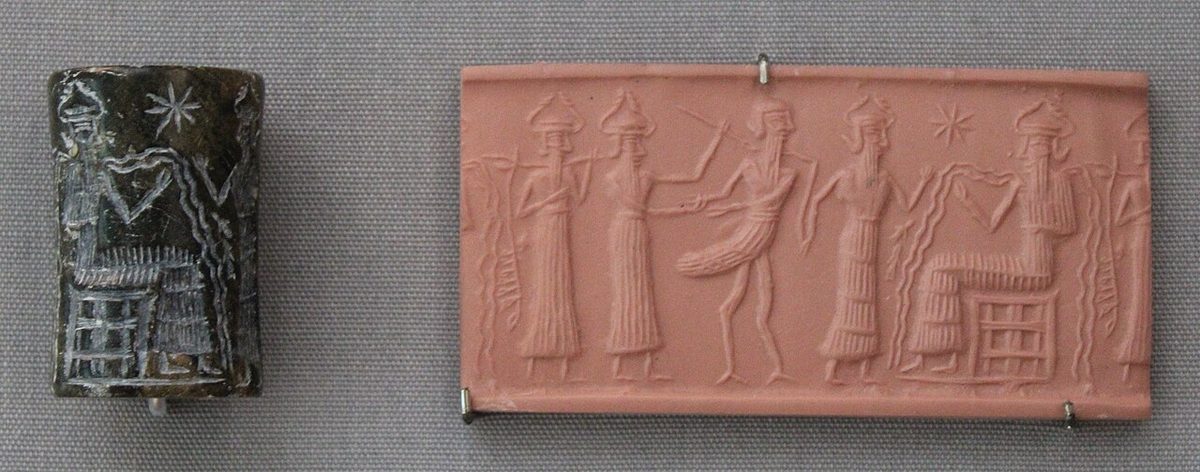
In Sumer they called the keeper of that spring Enki, Lord of the Earth. In Akkad and Babylon they called him Ea, House of Water. He is the god of fresh water, wisdom, magic, pottery, metalcraft and clever mercy. Before a brick is laid or a bronze blade is poured, the shape of the thing waits inside Enki's aquifer. He builds living order out of fluid intelligence, and Mesopotamia left his cylinder seals, his twin shoulder streams and his reed-wall whisper as a working guide to design.
Form born out of hidden code
To ordinary sight, clay and stone come first, while ideas float above them like smoke. Yet in physics and ancient Sumer alike, the pattern arrives before the brick.
In her essay Is Bit It?, Jennifer Nielsen revisits John Archibald Wheeler's idea from 1989. Wheeler argued that every physical thing in the world, which he called it, springs from hidden code, which he called bit. Before solid mass takes shape in a room, a layer of structured answers and nonlocal quantum sharing sets its rules.
Sumer carved that truth on stone seals five thousand years ago. Beneath the city of Eridu rolled the Abzu, an endless reservoir of sweet water. Out of that depth, Enki sent up the rules of art, law, music and carpentry so cities could stand on the dry ground.
The clay makers and the whispering wall
This story is cut into cuneiform tablets from Sumer and Babylon, in the epics of Atrahasis, Enki and the World Order, and the Descent of Inanna.
In the oldest city of Eridu, Enki dwelt inside his shrine above the Abzu. With the mother goddess Ninhursag, he mixed clay from the deep with the breath and blood of a slain god. Together they shaped the first mortals to till the earth and keep the canals clear.
Years later, human clamor grew loud across the plain and broke Enlil's sleep in the upper sky. Enlil moved the great gods to drown mankind under a flood. He bound every god by solemn oath never to warn a mortal word for word.
Enki kept his oath and saved humanity in the same breath. He walked down in the night to the reed hut where a wise man named Atrahasis slept. Enki spoke no warning to the man's face. He pressed his mouth near the woven fence and spoke straight to the wall itself. Reed wall, listen carefully, he whispered. Tear down your house and build a boat, leave wealth behind and save living seed.
Atrahasis heard the murmur through the reeds. He measured the hull from Enki's numbers, sealed the timber with bitumen, and carried the seeds of life across the flood.
Even in the dark world below, Enki worked by design instead of force. When Inanna hung dead inside the underworld before her sister Ereshkigal, no warrior could break seven iron gates. So Enki scooped dirt from under his fingernail and shaped two clay figures, neither warrior nor king. They slipped beneath the gate like dust, echoed Ereshkigal's cries of pain until her heart softened, and brought Inanna home with the water of life.
Laws of the craft chamber
Two rules of design run straight through these clay tablets.
First, good craft follows a blueprint before a hand touches clay. Enki gave Atrahasis exact numbers for the boat while the sky was still clear. A builder who skips the measuring cord wastes timber on crooked walls.
Second, when the front gate slams shut under rigid rules, intelligence finds a lawful side door. Enki never broke his oath to Enlil. He never fought Ereshkigal with a spear. He spoke to a reed fence and sent two handfuls of clay to listen. Mercy paired with craft outlasts brute decree.
Rewriting the living blueprint
Sound, water and inherited memory still follow that rule of pattern before brick.
Lee Carroll, speaking for Kryon in The Hidden Attributes of Innate, describes a smart field inside the body that carries family ancestry and soul memory. Kryon teaches that cells are not trapped inside blind chemistry. When mind addresses that inner partner directly, old inherited codes can be rewritten from inside.
Maia Nartoomid, in her New Earth Star writings, describes scalar waves as carriers of light codes that speak to DNA. They restore a person's blueprint when old structures crack.
Tom Kenyon and the Hathors describe this work through sound. In his notes on Ascension Codes and Dimensional Attunements, Kenyon says vocal tones act like sound blueprints. They carry patterns into the body's water and etheric double without strain.
All three point back to what Sumer saw beside the rivers. Beneath clay runs a living stream of code waiting for form.
Reading the goat-fish and twin streams
Four figures carved on Ea's cylinder seals show how insight turns into practical work.
First are the twin rivers pouring from Enki's shoulders, alive with swimming fish. Long before Greek sky charts named Aquarius the Water-Bearer, Babylon carved Ea pouring sweet water from both shoulders onto the dry earth. Ideas only feed a town when they flow out of the spring and reach the fields.
Second is the suhurmashu, the goat-fish swimming beside his throne, with the forelegs of a mountain goat and the tail of a fish. Later sky maps turned that creature into Capricorn. The symbol binds two skills rarely found together: swimming in the deep aquifer while climbing rock step by step.
Third is the woven reed wall of Atrahasis. Reeds bend in wind and let whispers pass through tiny gaps where stone walls stay deaf. True craft listens to thin cracks where life asks for a boat.
Fourth are the me, the hundred tablets of civilization stored in Eridu: music, carpentry, metalworking, fair judgment, plain speech and mourning. Enki treated every trade as sacred code. Even when Inanna carried those decrees to Uruk in her boat, he blessed their spread across the land.
Brother to the storm and father to the scribe
Enki never works outside his Mesopotamian family circuit.
His half-brother Enlil holds the upper air, collective law and the storm that sweeps excess off the board. Enki holds the aquifer below, guarding individual spark and craft so lineages do not vanish in one sweep. When Enlil threatens wipeout, Enki designs the ark. When Inanna falls into Ereshkigal's dark house, Enki sends witnesses made of clay.
Out of Enki's house in the Abzu came Marduk, who later ordered Babylon's sky, and Nabu, patron of scribes and clay tablets. Insight rises from water, enters craft through the hands, and leaves a mark on clay.
Enki-Ea in Aquarius, Capricorn and Mercury
In modern astrology, Enki-Ea meets the chart along the hinge of Aquarius and Capricorn, guided by Mercury, Saturn and Uranus. Aquarius carries his original picture, the Water-Bearer pouring living pattern from his shoulders for the good of the city. Capricorn holds his goat-fish emblem, marrying deep intuition with mountain-goat stamina and skill.
Babylonian sky keepers watched Mercury and Saturn closely on clay star lists such as Mul.Apin, while Uranus was discovered only in 1781 and belongs to modern astrology. In a birth chart, Mercury handles the reed-wall message, the numbers and the tool in the hand. Uranus marks sudden workarounds when systems lock down. Saturn supplies the bitumen and brick so a blueprint floats when rain starts.
Listening beside the reed wall
Call on Enki-Ea when a craft problem resists force, when a frame feels locked on every side, or when you need a clear design before laying down heavy work. Bring a stubborn build that asks for skill instead of brute force. His water feeds lifeboats and gardens.
Come near dawn or beside a tap or spring. Set a glass of fresh water beside a blank sheet of paper and a pen on a wood table.
Sit with your feet flat and shoulders loose, keeping your chest open like a river basin. Take five slow breaths. Imagine sweet spring water rising beneath your heels, as still as the Abzu under Eridu.
Write your single craft question onto the paper in one plain line. Think of Atrahasis pressing his ear to the reed wall. Instead of pushing against a locked door, ask what side passage, missing measure or tool sits beside the wall.
Write down the first three steps that rise without forcing them. Look into the water and check which step builds something sturdy instead of show.
When the three steps stand on paper, cap your pen and weigh the sheet down beneath a stone or brass tool on your workbench. Carry the glass outside or to a potted plant and pour the spring water onto the soil so the pattern reaches living roots. Pick up one real tool of your trade, thank the Lord of Eridu, and make the first physical mark before the hour ends.
Questions people ask about Enki and Ea
Who is Enki or Ea in Mesopotamian mythology?
Enki in Sumer and Ea in Akkad is the god of fresh water beneath the earth, wisdom, magic and crafts. Dwelling in the Abzu beneath Eridu, he shaped mortals from clay and saved life during the Flood.
How did Enki save humanity from the flood?
Bound by oath not to warn people directly, Enki spoke the size of an ark to a reed wall while Atrahasis slept on the other side. He kept his word while passing the blueprint through.
What does the goat-fish symbol mean?
The goat-fish, or suhurmashu, joins a mountain goat's forelegs with a fish's tail. It stands for Enki's double mastery of fluid wisdom and earthly climb, later becoming Capricorn.
How is Enki connected to the sign of Aquarius?
Mesopotamian seals show Enki pouring twin streams of water with swimming fish from his shoulders. That Water-Bearer figure passed into star lore as Aquarius.
How can you work with Enki for craft and vocation?
Bring one design question beside water at dawn. Trace the simplest steps on paper without straining against locked doors, and close by pouring the water onto earth.
The spring beneath the bricks
Enki and Ea represent patient craft intelligence, the hidden water that turns river clay into a boat that floats.