Over the mudbrick parapet of Uruk at dusk, one bright star climbed above the Euphrates reed beds and burned clear against the violet horizon. For months she hung low in the west after sunset, then dropped toward the sun's glare and vanished from sight until the same fire leaped out before sunrise, sharp as a blade.
In Sumer they called her Inanna, Lady of Heaven. Later cities in Akkad and Babylon named her Ishtar, Queen of Heaven and Earth and Lady of Battles. She is the goddess of desire, love, war and kingship in ancient Mesopotamia, waking longing in the evening and courage at dawn. Her priests carved clay tablets, temple hymns and glazed blue gates to track her path and cross her threshold safely.
One star in two lights
Later Greece split love and war into two gods, Aphrodite and Ares. Mesopotamia kept both inside one goddess. To a modern reader, a goddess of tenderness and battle sounds like a riddle. To a watcher on a roof in Ur, there was no riddle at all.
Babylonian sky keepers named the planet Venus Dilbat, the star of Ishtar. They wrote her movements down for centuries on clay records like the Venus Tablet of Ammisaduqa. Watch Venus long enough, and you see why she holds two faces. As the Evening Star, she shines warm above the sunset, drawing eyes and hearts toward union. As the Morning Star, she leaps ahead of the sun like a warrior opening the day. Between those two phases, she vanishes into the sun's light for days, as if she had died and gone below the ground.
Iain McGilchrist writes about this very riddle in The Matter With Things under the name of the Morning Star Paradox. Both the Morning Star and the Evening Star are the planet Venus. Yet one appears before dawn and the other after dusk, so analytical thought tries to split one living being into two separate objects. When you change the light, narrow thought assumes the being changed. Inanna-Ishtar is the proof that one force wears two faces without breaking in half.
The boat of decrees
Two great stories on clay show how she acts in heaven and below the earth. The first is the story of Inanna and the Me.
Inanna set out from Uruk in her Boat of Heaven and sailed south along the Euphrates toward Eridu. Eridu was the freshwater house of Enki, god of wisdom and craft, who kept the me, more than a hundred decrees that hold human life together. Among them were kingship, music, carpentry, truth, grief, battle and sexual joy.
Enki welcomed her warmly and spread a feast of barley beer and sweet cakes. Cup followed cup through the afternoon. As the drink loosened his guard, Enki began to give the decrees away, one after another, into Inanna's hands. She loaded every decree onto her boat and pushed off from the reed bank before his head cleared.
When Enki woke and found his vault empty, he sent his servant Isimud and monsters of the river to stop her boat. Six times the monsters seized the prow. Six times Inanna's minister Ninshubur struck them back and held the oars firm. The Boat of Heaven reached the quay of Uruk, and Inanna carried the arts of city and heart straight into human hands.
The seven gates of the dark
Her second story moves in the opposite direction, from the high temples down into the dust.
Inanna set her ear to the Great Below. She left seven temples behind her and walked toward Irkalla, the land of no return, ruled by her elder sister Ereshkigal. Before she left, she gave one order to Ninshubur. If she did not return in three days, Ninshubur was to beat the drum, tear her garments and cry out to the high gods for her life.
Inanna dressed in every mark of her rank. She put on her Shugurra crown, her lapis rod and cord, her twin beads, her breastplate, her gold ring and her pala robe. She walked down to the gate of lapis lazuli and struck the door.
Neti, the gatekeeper, went inside to ask Ereshkigal what to do. The queen of the dead grew cold with anger and gave one order. Bolt the seven gates, then open them one by one, and at each threshold take away one piece of her gear.
At the first gate, Neti lifted the crown from her head. Inanna asked why, and Neti answered that the ways of the underworld are exact and must not be questioned. At the second gate he took her beads. At the third gate he took her breastplate. At the fourth gate he took her ring. At the fifth gate he took her lapis rod and cord. At the sixth gate he took her royal robe. At the seventh gate he stripped away the last garment from her skin, until she entered the inner hall naked and bowed low.
Ereshkigal sat upon her throne beside the seven judges of the dead. They fixed their eyes upon Inanna, the eyes of death. They spoke the word of wrath, and at that look Inanna turned into a corpse and hung upon a peg on the wall.
Three days and three nights passed. Up above, Ninshubur beat the drum and went from house to house among the gods. Enlil turned away. Nanna turned away. Only Enki in Eridu heard her cry. He scraped the dirt from under his fingernails and shaped two small creatures, neither man nor woman, the kurgarra and the galatur. He placed the food of life in one hand and the water of life in the other, and sent them slipping like flies under the bolted gates of Irkalla.
Inside the dark hall they found Ereshkigal groaning like a woman in birth pain. They did not argue with her or draw a blade. When she cried out about her belly, they cried out with her about their bellies. When she cried out about her back, they mirrored her groans about their backs. Moved at last because someone shared her pain instead of judging it, Ereshkigal asked what gift they wanted. They pointed to the corpse upon the wall. She gave it over. They sprinkled it with the water of life and fed it the bread of life, and Inanna stood up alive.
Yet no one leaves the land of the dead without leaving a substitute behind. Demons of the underworld climbed out beside her, seizing at her skirts. When they reached for loyal Ninshubur, Inanna held them back, for Ninshubur had mourned in sackcloth. When they reached for her faithful servants, she spared them too, for they had wept in the dust. Then she reached Uruk and found her husband Dumuzi dressed in fine robes, sitting high upon a throne without a single tear for her absence. Inanna fixed the eyes of death upon him and handed him to the demons.
What the two stories encode
Placed side by side, the two epics state clear laws of consciousness.
First, nothing false survives a real threshold. Inanna did not go down to Irkalla in rags. She went down wearing every badge of pride and office. At each gate, another defense fell to the floor. Power that survives after every title is taken away does not shake when praise disappears.
Second, pain yields to witness where force fails. Swords could not break Ereshkigal's gate. Enki's tiny mourners had no armor at all. They matched her cry inside the dark, and the locked door opened.
Third, loyalty shows itself in winter, not in feast time. Inanna spared the friends who stood with her in the dust and turned away from the consort who enjoyed his comfort while she hung on the peg.
Passing through the dark between states
Physics knows a moment that looks like those seven gates. In A Brief History of Time, Stephen Hawking describes a phase transition. When a system cools or heats across a critical edge, its old symmetry breaks. Everything sits in flux before a new order settles into place. A solid melts before it flows as water. Inanna's descent is a phase transition of consciousness. The old form dissolves so a new state can rise.
Tom Kenyon and the Hathors teach a kindred law from an ancient Egyptian temple. In Wrestling Crocodiles in the Courtyard of the Sun, he writes of neophytes swimming underwater at Kom Ombo. Two tunnels opened beneath the stone. One shone with surface light and ended in rock. The dark tunnel led out to air and life. Initiation asks a person to tell false glare apart from the real passage through the dark. The Hathors also trace their own path through Venus. They say they entered this solar system through Sirius and the etheric realms of Venus before guiding temples on Earth.
Carla Rueckert's Law of One transcripts give another piece of the sky picture. Those sessions state that the group speaking through her grew through third density upon Venus. Under the veil of forgetting, every shock and longing becomes catalyst. That friction is what sharpens choice and love.
In her message on three days of darkness, Anne Tucker describes a similar crossing. Stepping from one level of consciousness to another feels like entering an abyss where old habits break down. Holding tight brings fear. Letting the old shell fall lets a new voice rise from the heart. In her talk on three levels of desire, she adds that wanting shifts from empty hunger into a bridge of light once those walls yield.
Maia Nartoomid points straight to the sky pattern behind it. Venus shines as Evening Star, vanishes into darkness, and returns as Morning Star. That loop is the pattern of descent and rebirth. She also describes an etheric Temple of the Morning Star linked to the Great Pyramid, where light enters stillness before waking a new current below.
The reed loop, the star and the lion
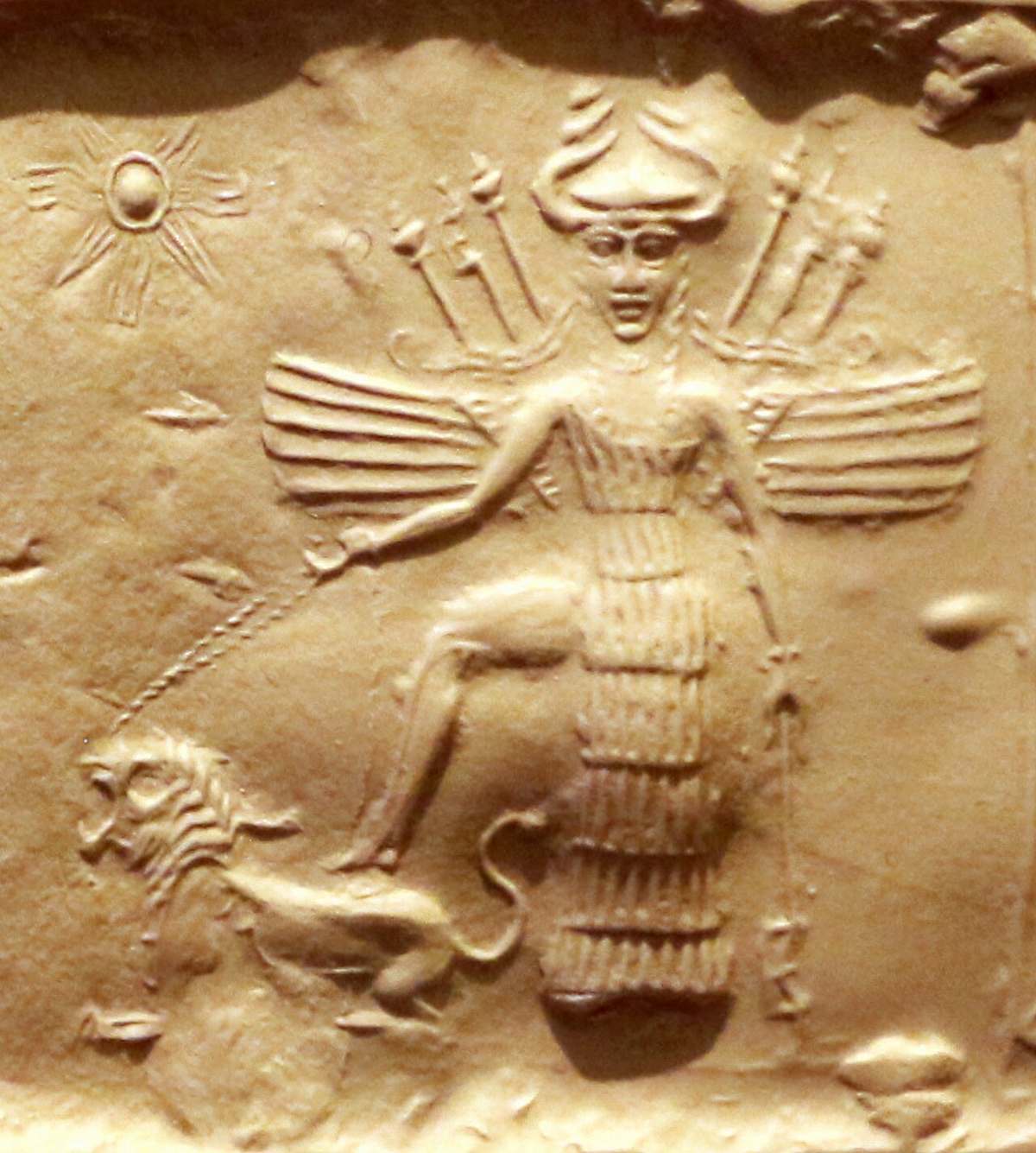
Walk past the glazed blue bricks of Babylon's Ishtar Gate, and four signs beside her mark the working parts of her temple.
Begin with the oldest sign of all. Before she wore crowns or armor, the Sumerian picture for Inanna was a bundle of reeds tied into a curved loop above a storehouse door. A storehouse holds grain, wool, dates and seed for the winter ahead. That loop teaches the base of her technology. Desire is not vague daydreaming. Real attraction builds a shelter, keeps provisions safe and tends living things through dry months.
Next come the seven ornaments stripped at the gates. The turban crown is public name. The measuring rod and cord are sharp judgment. The beads, breastplate and gold ring are charm, status and display. The robe is the final outer shield. Each emblem names a layer people wrap around themselves to feel safe in a crowd. Setting them down one by one is how the vessel clears.
Above her head shines the eight-pointed star-rosette. Eight rays point outward in every direction at once, north, south, east, west and the four corners between. A star with eight rays does not pick one small corner and hide. It radiates from its center evenly in all directions.
Beneath her feet walks a roaring lion. Culture often tells people that tenderness must stay soft and compliant, while strength must turn cold and hard. Ishtar standing calm upon a lion shows both forces fed by the same root. Fierce nerve and warm desire draw from one fire.
The house of the moon and sun
Inanna did not stand alone in the Sumerian sky. She was the daughter of Nanna-Sin, the moon god of Ur, and his wife Ningal. Her twin brother was Utu, called Shamash in Babylon, the sun god who rises with his saw of justice. Her elder sister was Ereshkigal, queen of the deep earth.
Notice the circuit in that family. Feeling and tidal rhythm come first in the father moon. Out of that dark tide rise twin lights, clear daylight in Shamash and burning attraction in Inanna. And beneath them waits Ereshkigal, the root in the underworld where everything must return when its season ends.
At Ur around 2300 BCE, the high priestess Enheduanna wrote the first signed poems in human history, praising Inanna as the force that turns disorder into song. Even kings answered to that flame, because a ruler who forgot the storehouse or ignored real loyalty could not hold the crown for long.
Dilbat in the birth chart
In a modern birth chart, Inanna-Ishtar reads through the planet Venus, carrying the full weight of Babylon's Dilbat.
Look first at where Venus stands relative to the Sun. If Venus sits at an earlier degree in the zodiac than the Sun, she rose before dawn as the Morning Star. That placement carries Inanna's bold, direct, warrior face, stepping forward without waiting for permission. If Venus sits at a later degree behind the Sun, she set after dusk as the Evening Star. That placement holds her slow, magnetic, sensory face, drawing people in through warmth, art and patient presence. If Venus was retrograde or close to the Sun at birth, she echoes the days when Dilbat disappears behind solar fire to walk her own seven gates.
Check the lines between Venus and the heavier planets. Venus with Mars joins Ishtar's lion to her star, linking passion with action and conflict. Venus with Saturn asks desire to earn its keep through time and real loyalty. Modern astrology also watches Venus meet Pluto, discovered in 1930, and Black Moon Lilith, the lunar apogee point, where small talk burns away and candor steps back into daylight.
Look also at Taurus and Libra, and at the fifth, seventh and eighth houses when birth time is known. Together they show whether desire plays for applause on stage or stands firm through hard seasons.
Setting down the seven ornaments
Meet Inanna-Ishtar when something false has worn thin and you are ready to set it down. Bring what is real, since she strips illusions at the gate and spares only what endures.
Find her in the sky at dusk or before dawn when Venus shines near the horizon. Step outside or stand by a window and look toward her light.
At the start, place seven small items beside a slice of bread, a sweet date or a handful of grain on a plate. Use a ring, a watch, a key, a coat, a shoe or anything worn to meet the day. As you set each one down, name one mask or pride you carry out of habit. Keep no armor on your mind.
Sit upright with open hands on your knees. Breathe out slowly until the chest softens. Let whatever sits inside your chest rise without fixing it or judging it. If grief, anger or longing sits there, act like Enki's tiny mourners inside Ereshkigal's hall. Witness what hurts without lecturing it. Say softly in your mind: I see this, and I am here.
Hold that simple witness for ten slow breaths. Notice if your desire feels like hungry lack or an open flame ready to meet life.
When the ten breaths end, step back out of the underworld gate as Inanna reclaimed her crown at dawn. Pick up your seven items one by one and put them back on with clear purpose. Eat the date or slice of bread from your plate in silence to honor the storehouse, then return to one real task at home or work that keeps life fed.
Questions people ask about Inanna and Ishtar
Who were Inanna and Ishtar?
Inanna was the ancient Sumerian goddess of love, desire, fertility, war and heavenly rule, later known across Akkad, Babylon and Assyria as Ishtar. Worshipped above all at Uruk and praised in hymns by Enheduanna, she stood as one of Mesopotamia's highest deities.
Why did Inanna go down through seven gates?
In the Descent of Inanna, she walked to the underworld of her sister Ereshkigal. At seven gates, the keeper Neti took one royal garment or ornament at each threshold until she stood bare. The journey shows that borrowed rank and pride carry no weight before death, and that true renewal strips away every mask.
What do the eight-pointed star and the lion mean?
The eight-pointed star shows the light of Venus shining outward in every direction at once. The lion stands for raw solar courage and physical power. Together they show that desire and courage belong to one root instead of pulling against each other.
Why was Inanna linked to the planet Venus?
Babylonian sky watchers named Venus Dilbat, the star of Inanna-Ishtar, and tracked her across centuries on clay tablets. Her disappearance behind the sun and her two faces as Evening Star and Morning Star matched her descent into the dark and her fierce return.
How does Inanna-Ishtar show up in a birth chart?
She appears through the planet Venus, especially her sign, house and position ahead of or behind the Sun as Morning Star or Evening Star. Strong links from Venus to Pluto, Mars, Saturn and Lilith show where desire meets real testing and drops false pretense.
The star that returns whole
Inanna-Ishtar is the double star that walks straight through the dark, strips every borrowed crown at the gate and returns with both tenderness and iron whole.
To see how your natal Venus steps between fierce morning fire and deep evening attraction in your own chart, explore your Love Horoscope.