Out on the black evening marshes of southern Ur, a curved skiff built of bound reeds glides silently through dark water while the thinnest silver crescent breaks clear above the western horizon. Watchers standing on the ziggurat stairs hail that arc as the opening night of a new month.
In Sumer they called him Nanna. Later Akkad and Babylon named him Suen and Sin. He is the moon god of ancient Mesopotamia and the lord of Ur, keeping cattle and standing as father to both the sun and the evening star. He holds the pulse of tides, patience and returning light, and his brick ziggurat at Ur served as an open platform for reading time directly from the sky.
Time before the clock
Modern towns burn artificial daylight past midnight, until every hour looks the same. Ancient Ur lived inside the curve of the moon.
In The Order of Time, Carlo Rovelli writes about time before mechanical clocks and synchronized railway timetables. For millennia, human beings measured time by the turn of day and night, the seasons, and the phases of the moon. In the ancient world, time was the counting of real change across sky and living creatures. When a culture forgets the moon, it loses the pulse that keeps effort and rest in tune.
Father of sun and star
In Sumerian myth, Nanna was the firstborn son of sky lord Enlil and grain lady Ninlil at Nippur. His wife was Ningal, the Great Lady of Ur. Together they gave birth to Shamash, the sun god, and Inanna, the planet Venus.
Put that family beside modern habits, and the order stands out at once. The moon is older than the sun in Sumer. Feeling, rhythm and rest come before bright daylight action and fierce desire. At Ur around 2300 BCE, the priestess Enheduanna wrote temple hymns to Nanna. She is the earliest named poet in history, and she sang of him as the vessel guiding river water and temple order.
Tom Kenyon and the Hathors teach a matching law in White Gold Alchemy. Inside the subtle body, solar gold carries active heat down the right side of the spine. Lunar silver carries cooling calm down the left side. Without lunar silver, solar drive overheats and scatters. With silver present, the vessel holds its balance during times of change.
The river voyage and the eclipse
Two old tales reveal how Nanna-Sin moves through blessing and shadow.
In the poem of Nanna's Journey to Nippur, the moon god does not march with chariots or weapons. He builds a swift boat from marsh reeds. He loads it with cattle, jars of white milk, cream, reeds and winter gifts. He sails north along the canals to Nippur and greets local shrines along the bank. When he reaches his father's dock, Enlil welcomes him and pours blessing over Ur's pastures, rivers and harvests. His rule flows like floodwater filling dry channels.
The second story comes from the Late Babylonian myth of the eclipse. Seven storm spirits rose against Sin in the night and wrapped his face in copper shadow. Sin did not hurl lightning or panic in the dark. Far away in the deep waters, wise Ea-Enki saw the darkening moon and sent word to Marduk. Down in the courtyards of Babylon, priests and citizens lit clay torches beside the cooling light. They waited calmly beside their lamps until the seven spirits withdrew and the silver horns shone again.
The law of the tide and the lamp
Two laws of water and watchfulness rise from these stories.
First, buoyancy travels further than brute force. A reed skiff cannot fight a river current head-on with heavy oars. It rises with the water, turns around sandbars and brings the cargo home whole.
Second, darkness ends when its transit finishes. During an eclipse, panic breaks nothing except the person who panics. Watching calmly beside a small lamp lets the shadow cross the face of the sky until light returns on its own measure.
Physics treats eclipses in a similar way as moments of truth. In A Brief History of Time, Stephen Hawking recalls how Aristotle watched the round shadow of Earth cross the moon during lunar eclipses. That curved shadow proved Earth was a sphere. Centuries later, during the solar eclipse of 1919, astronomers saw starlight bend past the dark disk of the sun and proved Einstein right. When bright glare dims for a few minutes, hidden truths step into view.
In her teachings on three days of darkness, Anne Tucker speaks of dark intervals in consciousness in the same spirit. She says fear flares up when the mind tries to grip an unfamiliar blank space. When a person stops fighting the dark and rests inside the heart, the passage completes itself and new sight opens.
The reed boat, the horns and thirty
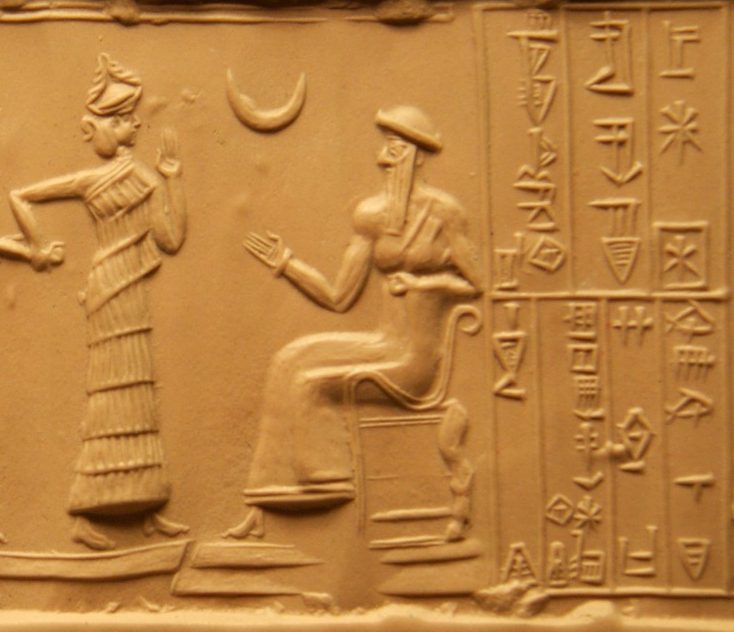
Look at the stone carving of King Ur-Nammu's stele, where the crescent hangs above the royal scene. In Mesopotamia, that thin arc was two things at once.
To boatmen on the southern marshes, the horizontal crescent looked like a curved reed skiff gliding across black water. To herdsmen on the plains, those same tips looked like the upturned horns of a bull calf. His chest and beard gleamed deep lapis blue. Water patience and bull strength sit inside one line. Yielding to a tide does not mean weakness. It means carrying heavy life without smashing into the bank.
Nanna also held the sacred number thirty, the count of days from crescent to crescent. Sumerian scribes built temple leases, silver loans, planting days and rest days around his waxing and waning quarters. Feeling in Mesopotamia was never chaotic guesswork. It ran on exact measure.
The moon in the birth chart
In a birth chart, Nanna-Sin lives in the Moon, the oldest timekeeper in Mesopotamian sky lore.
Look first at your natal Moon by sign, house and aspect. Notice also the lunar phase at your birth. People born under a waxing crescent often carry trust into uncertain beginnings. Those born near a full moon meet life through strong mirrors and open encounters with others. Those born under a dark waning crescent carry Enheduanna's memory, gathering wisdom in solitude before a new cycle starts.
Check the fourth house of roots and home, and placements in Cancer. Check whether your chart belongs to the night sect, with the Sun below the horizon. Above all, follow your monthly Lunar Return. Every twenty-seven days and a fraction, the moving Moon returns to its birth degree and sets the inner weather for the four weeks ahead.
Keeping watch by the lunar lamp
Come to Nanna-Sin when your mind runs hot from screens, or when a season of waiting tests your patience. His watch teaches patient timing instead of rush.
Choose his hour at dusk or at night. Monday belongs to the moon, and any waxing crescent or full moon evening works well. Step outside without headphones and look up at the sky. If clouds cover the sky, light one small candle or oil lamp indoors beside a blank notebook.
Sit calmly with both hands resting palms down on your knees. Breathe out slowly until the jaw and shoulders drop. As the Hathors describe in White Gold Alchemy, picture a cool stream of silver rising along the left side of the spine toward the center of the head. Let it cool any leftover glare from the day.
Keep a three-line log across one full month of twenty-nine days. Note the moon phase beside your energy and sleep each evening. Watching your real ebb and flow breaks the habit of scolding yourself during natural waning days.
If you stand inside a dark or unclear month, do what the citizens of Babylon did during the eclipse. Keep one small lamp lit. Sit calmly beside what you cannot rush, and refuse to steer the boat into pilings out of fear.
When your watch ends, pinch out the candle flame or step back indoors from the night air. Mark tonight's moon phase on one line of your thirty-day log, pull the blanket over your shoulders, and give the dark hours over to deep sleep.
Questions people ask about Nanna and Sin
Who was Nanna-Sin in Mesopotamian myth?
Nanna in Sumer, known as Suen or Sin in Akkad and Babylon, was the moon god of ancient Mesopotamia. Firstborn son of Enlil and Ninlil, husband of Ningal and father of Shamash and Inanna, he ruled the great temple city of Ur.
Why is Nanna linked with both a boat and a bull?
Low above the twilight horizon, a crescent moon looks like a curved reed marsh boat and also like the horns of a bull. Poets joined both images to show waterborne patience paired with fertile strength.
Who was Enheduanna?
Enheduanna was the high priestess of Nanna at Ur around 2300 BCE and the daughter of King Sargon of Akkad. She is the oldest named author in human history, leaving hymns in praise of Nanna and Inanna.
How did Mesopotamia use the moon in calendars?
Babylonian and Sumerian cities began each month at the first evening sighting of the thin waxing crescent. They anchored contracts, farming tasks, rest days and festivals around his thirty-day cycle.
How does Nanna-Sin appear in a birth chart?
He speaks through your natal Moon, its phase at birth, its house and its links to other planets. Tracking your monthly Lunar Return shows how your inner tide shifts every twenty-seven days.
The silver boat upon the dark
Nanna-Sin is the silver boat upon dark water, the keeper of tides who knows that every shadow passes in its own measure.
Because Nanna measures the returning twenty-seven-day wheel of feeling and rest, explore your Lunar Return to read the emotional weather of your coming month.