At the eastern rim of Mesopotamia, twin peaks stand dark against the last stars of Mount Mashu while scorpion keepers draw back the turquoise bolts of dawn. Out of that stone cleft steps a god lifting a toothed blade of gold. He saws through the eastern ridge, and bright daylight spills across the plain.
In Sumer they called him Utu. Later Akkad and Babylon named him Shamash. He is the sun god of ancient Mesopotamia, the judge of oaths, the keeper of travelers and the witness of every bargain. His rule turns on open sight and exact proportion, and his temples at Sippar and Larsa taught how human speech and action stay straight under the sun.
Sun born of the moon
Mesopotamia gives modern readers a surprise in the family tree of the sky. The sun did not make the moon. Nanna-Sin, the moon god of Ur, and his wife Ningal stand as the elders. Shamash rises as their son, twin brother to Inanna, the star Venus. His wife is Aya, the gentle goddess of dawn.
That order is deliberate. Before harsh midday glare hits the courtyard, lunar rhythm and still night come first. Only out of calm reflection does daylight emerge without burning the fields.
Tom Kenyon and the Hathors teach a kindred balance in his work on solar energy. In his message Partaking From the Solar Winds, the Hathors explain that the sun carries an etheric field whose charged winds stream across Earth every hour. A human being receives that stream through the Ka, the subtle body, by resting in gratitude so the field acts as an attractor instead of a shock. In White Gold Alchemy, they add why solar fire cannot stand alone. Gold light is active and stimulating, while silver lunar light is calming and receptive. When solar gold meets lunar silver along the spine, clarity rises without scorching the vessel.
The gate, the king and the forest
Three old stories show how Shamash acts in heaven and on earth.
Every morning, human-faced bull beings and scorpion keepers unbar the gates of Mashu for Shamash. He rides across the open sky above kings and field hands alike. Nothing hides beneath a roof when he passes overhead. He watches merchants weigh silver in the bazaar, widows pleading at city gates and travelers crossing dry roads far from home. When evening comes, he steps into the western earth to judge the dead, carrying the same light beneath the ground that warmed the living by day.
On the basalt stone of the Code of Hammurabi, now kept in Paris, a carved scene sits above the laws. King Hammurabi does not sit on a throne boasting that he invented justice. He stands upright with one hand raised in silence before seated Shamash. Out of Shamash's right hand, the king receives a straight rod and a coiled cord. Even the ruler answers to a measure older than his crown.
In the Epic of Gilgamesh, the wild king and his friend Enkidu prepare to march toward the Cedar Forest to face the monster Humbaba. The elders of Uruk do not entrust the pair to war gods alone. They place them under the eye of Shamash. When Humbaba shakes the trees and raises terror on the mountain, Shamash summons thirteen fierce winds to pin the giant in the open. Courage that walks without deceit finds help from the sky.
The law of the saw and the cord
Two laws of open sight and proportion cut straight to the bone of these tales.
First, light separates before it warms. Shamash carries a saw at dawn because real sight divides what is true from what is crooked. Soft cheer that refuses to name a false weight leaves the weak unprotected. Clarity draws a straight line first, and warmth can then nourish without feeding deceit.
Second, the measure stands above the ruler. Nobody owns the rod and cord. When a person uses one rule for friends and a harsher rule for strangers, the cord is already broken.
Measure in physics and consciousness
In the courts of Sippar and Larsa, judicial light never floated above the world like an idle lamp. The judge, the merchant's balance and the bronze weights formed one physical act that decided who ate and who went hungry.
Karen Barad describes a kindred law in Meeting the Universe Halfway. She shows that an observer and a measuring tool never stand outside what they test. Every cut made by a measuring apparatus enters a real meeting inside the world and carries accountability for what comes to matter. Shamash's scales and cord say the same thing in bronze and stone. How you measure another person shapes the world you both inhabit.
Lee Carroll, speaking as Kryon in his Columbus channel, describes this law through balance. One person holding balanced awareness inside a crowded room acts like light switched on inside the dark. Coherence broadcasts itself without shouting, and others begin to see clearly around it.
The saw, the rod and the disk
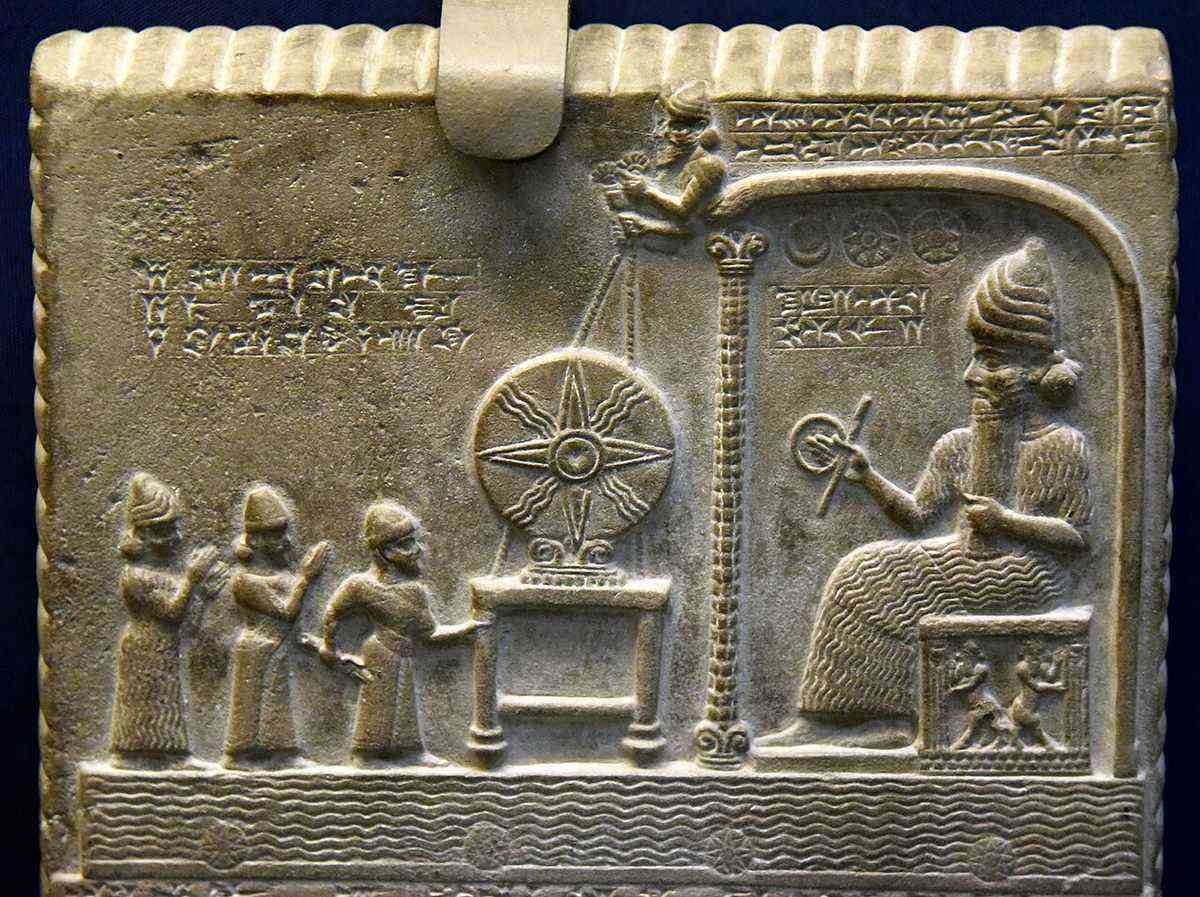
In the ninth-century BCE Sun God Tablet from Sippar, now in the British Museum, Shamash sits inside his shrine holding his instruments.
First is the shasharu, the serrated golden saw resting in his hand. At dawn it cuts the stone of Mashu so the sun can break free. At noon it cuts through tangled excuses and false oaths. As a tool, the saw reminds us that clarity is sharp. It does not blur edges to keep everyone comfortable.
Beside the saw rest the straight rod and coiled measuring cord. In ancient canal towns, surveyors walked flooded fields every spring with wet flax cord and bronze rods so rich neighbors could not move field stones in the dark. In the mind, rod and cord mean holding yourself to the exact rule you expect from others.
Above the shrine shines his four-pointed solar disk. Between four sharp diamond rays run four wavy streams of water. Light from Shamash joins keen thought to living warmth. It shines without turning cold, and it warms without blinding.
The sun in the birth chart
In astrology, Shamash lives in the Sun itself, placed at the center of the wheel just as Babylonian sky watchers tracked his daily course between east and west.
Look at your natal Sun by sign, house and aspect. Notice whether you were born by day, with the Sun above the horizon line, or by night, with the Sun below it. In a day chart, solar clarity often moves openly into public work and visible duty. In a night chart, Shamash shines inward first, guarding conviction behind the scenes.
Check how the Sun meets Saturn, Jupiter and the Nodes. Sun with Saturn carries Hammurabi's rod and cord directly into character, testing promises through hard seasons until weight holds true. Sun with Jupiter widens fair vision and guards travelers across unfamiliar borders. Sun near the Nodes marks where a life must step into plain sight instead of hiding in old shade.
And follow your Solar Return each year. Once every twelve months, the moving Sun returns to the exact degree and minute where it stood at your birth. That crossing opens a new Mashu gate for the year ahead.
Meeting the sun with rod and cord
Come to Shamash when half-truths have tangled your week, or when a major promise needs straight edges. Bring a deal or duty you mean to weigh fairly, since his light measures the speaker first.
Meet him at dawn or within an hour after sunrise, facing east toward early light before screens and voices fill the room. Set a straight wooden stick or ruler on a plain table before you.
Stand tall or sit upright with your heels pressed evenly onto cool stone or bare wood. Rest your awareness on the center of your chest and breathe slowly as early warmth hits your face. As the Hathors teach, open a feeling of plain gratitude for the light reaching Earth, letting your body receive the morning stream without strain.
Name one place in your life where you have been hiding an unpaid debt, an unclear promise or a double standard. Speak the plain fact aloud into the daylight. Ask what the straight rod and cord demand of you today. Keep the answer simple and small enough to act on before sunset.
Noon glare without rest dries out the soil, and Shamash himself returns to Aya's gentle dawn house each evening. Lay the straight wooden ruler flat along the edge of your table where your eye can measure by it. Step out of direct glare into roof shade, speak Aya's name softly to mark the border between day and night, and carry out the single concrete promise you named before the sun goes down.
Questions people ask about Shamash
Who was Shamash in Mesopotamian myth?
Shamash, known earlier in Sumer as Utu, was the ancient Mesopotamian god of the sun, justice, truth and travelers. Son of moon god Nanna-Sin and Ningal, and twin brother of Inanna, he ruled great temples in Sippar and Larsa.
Why is Shamash shown with a saw, rod and cord?
Ancient carvings show him holding a toothed saw to cut through mountain rock at dawn and sever false excuses in court. His straight rod and coiled cord were surveyor tools standing for equal measure applied to kings and ordinary citizens alike.
How does Shamash appear in the Code of Hammurabi and Gilgamesh?
Atop the Code of Hammurabi stele, Shamash hands the rod and ring of law down to the standing king. In the Epic of Gilgamesh, he shields Gilgamesh and Enkidu in the Cedar Forest by sending thirteen winds against Humbaba.
Why was the sun called the child of the moon in Sumer?
Sumerian priests counted months from the first evening crescent moon and saw lunar order as the parent of conscious daylight. Light rises out of calm rhythm instead of acting like blind heat.
How does Shamash connect to a birth chart?
Shamash maps directly onto the Sun in your natal chart and your yearly Solar Return. His aspects to Saturn, Jupiter and the Nodes show how you keep faith with your own word and walk in open daylight.
The light that measures
Shamash is the witness at the eastern gate, the open daylight that holds king and traveler to one straight measure.
Each year the Sun crosses back over its birth degree and opens a fresh gate. Look at your Solar Return to see what your coming year places in full daylight.