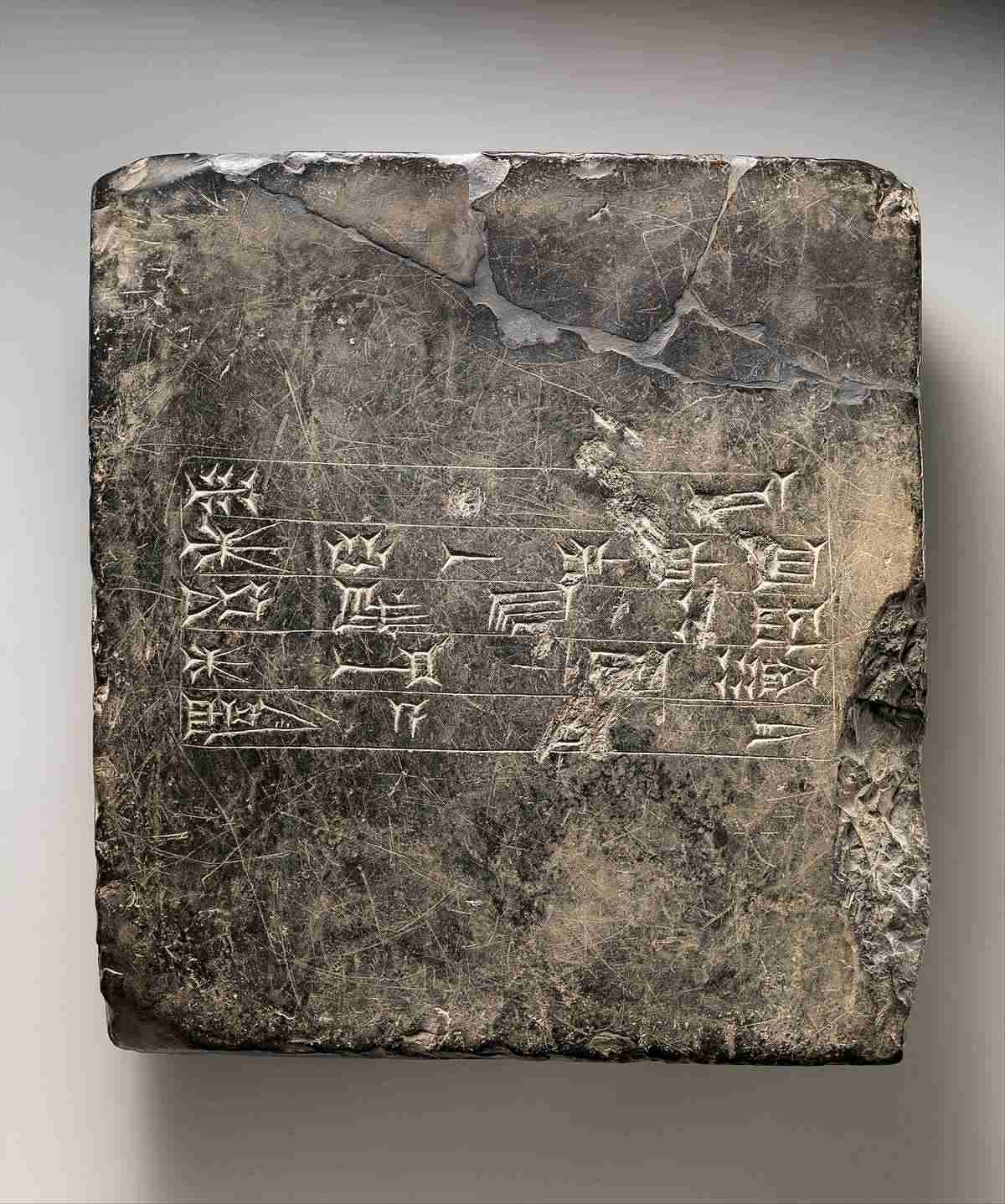
At Nippur, a sharp wind struck the cedar beams of the mountain temple. It rattled the bronze gate bolts before dawn broke over the plain. Outside the mudbrick walls, green barley stalks bent in one long wave while dust lifted off the threshing floors and cleared the streets.
In Sumer that wind was Enlil, Lord Air and Lord Command. He was king of the gods at Nippur, keeper of the Tablets of Destinies, and voice of collective order across the world. Where his brother Enki worked underground in freshwater springs, Enlil ruled the open sky between mountain and cloud. He embodies atmospheric pressure, executive timing and the strict limit of what a land can carry. Sumer built its stepped brick mountain at Nippur to keep human law in tune with that moving breath.
An atmosphere kept alive by breath
Air is never empty nothing. Every breath a creature draws pushes against a real weight of atmosphere resting on the plain. That weight shifts between high pressure and low pressure from hour to hour. When stale heat builds under a heavy lid of air, wind rises to break the seal and turn the valley over.
Sumer saw that living pressure and gave it a king. Enlil is not dead emptiness above our heads. He is the active breath between sky and ground that wedges space open enough for life to stand up and answer for its weight.
The pickaxe, the exile and the flood
This story stands on cuneiform tablets from Nippur, in the Song of the Pickaxe, Enlil and Ninlil, and the Atrahasis epic.
At the dawn of things, An the sky father and Ki the earth mother held each other so tightly that no seed could lift its head. Enlil rose between them as a rushing wind. He thrust heaven overhead while setting earth firm beneath his feet. Then he forged the first pickaxe with a golden tooth, struck the crust open at Nippur, and out of that furrow the first people sprouted like barley.
Enlil was fierce and young before he learned measure. When he took Ninlil by force beside the canal in Nippur, the assembly of gods did not excuse their king. They banished Enlil toward the gate of the underworld. Ninlil followed him down the road. At each river crossing Enlil took the shape of gatekeeper and boatman, conceiving Nanna the moon and three dark-realm guardians along the path. Only after walking that hard descent did he return to Nippur fit to hold the Tablets of Destinies.
Centuries later, cities swelled and mortal noise roared up until the gods could not sleep. Enlil tried plague, drought and famine to stop the clamor. Nothing slowed the racket. At last he loosed the Great Flood, riding the storm wind over the river walls until the plain became a flat sea.
When the storm cleared, Enlil smelled cedar smoke rising from Utnapishtim's offering on the mountaintop. His grief struck as deep as his anger. He wept at how close earth had come to complete emptiness. Stepping aboard the stranded ark, Enlil laid his hands upon Utnapishtim and his wife and granted them immortal breath at the mouth of the rivers.
Laws of the open sky
Two principles of pressure and carrying limit govern every story told at Nippur.
First, life requires clear space between pressure and ground. When Enlil pushed An and Ki apart, he gave consciousness room to stand and breathe. Crowding every hour with clamor and greed collapses that air space until nothing grows straight.
Second, any system pushed past its carrying limit calls down its own storm. Enlil did not hate crops or builders. He answered collective overload the way a crowded boiler answers excess steam. When noise stops respecting the sky, the wind clears the plain so life can start again with lighter weight.
Breath as the link between person and Earth
Human breath, planetary winds and the calm center inside a storm follow that same law of pressure.
In her message How We Will Help Earth Rise, Anne Tucker speaks of breath as an air of remembrance linking human awareness to the planet. As Earth reshapes her rhythms, what happens in the atmosphere moves in step with human breath. In each exhale, a person releases fatigue and clinging, helping the wider field settle into new order.
Lee Carroll, speaking as Kryon in his 2015 Charlottesville and Istanbul talks, describes a new wind blowing across the planetary grid. That wind wakes ancient Earth nodes and clears old patterns. It asks people to match new timing instead of clinging to old calendars.
Tom Kenyon and the Hathors compare turmoil to a cyclone in The Eye of the Storm. Around the rim, fierce winds tear up weak frames. Right in the center sits a pocket of silence where a person can stand anchored in breath.
Reading the Mountain House and the tablets
Four objects from Nippur act as gauges between sky order and human hands.
First is the Ekur, Enlil's ziggurat temple in Nippur, whose name means Mountain House. Mesopotamia rose off the flat floodplains. Raising a stepped brick mountain into the wind gave kings neutral ground between rival cities, where no ruler held authority until Nippur confirmed him.
Second is the horned crown of divinity, stacked with curving bull horns rising tier upon tier toward heaven. Horns mark raw atmospheric force disciplined into office and duty.
Third are the Tablets of Destinies, the Dup Shimate pressed in clay and sealed in lapis. They represent cosmic law and collective timing, the calendar of seasons and consequences that no bribe can bend.
Fourth is the pickaxe tipped with bronze that Enlil carved for human hands. Law without labor stays empty air. The same god who commands storms hands mortals the tool to break clods, dig ditches and raise solid walls.
Son of heaven and earth, father of the moon
Enlil sits at the top of Mesopotamia's circuit between spirit, law and time.
Below him works his half-brother Enki in the freshwater Abzu, defending mercy and craft whenever Enlil's decrees grow sweeping. Beside Enlil stands Ninlil, lady of grain and south wind, softening cold command with harvest care. Out of Enlil's descent through the underworld gates came Nanna-Sin, the crescent moon who measures months across the sky, followed by Ninurta the ploughman.
Command in the air meets water below and time on the moon's face, keeping rule accountable to living earth.
Enlil across Jupiter, Saturn and Annual Profections
In astrology, Enlil shows up wherever Jupiter's sky kingship meets Saturn's strict limits, especially through the Air signs Gemini, Libra and Aquarius. Babylonian sky keepers watched both Jupiter and Saturn closely on clay star lists such as Mul.Apin. Jupiter sets the horizon, civic law and collective breath. Saturn holds the Tablets of Destinies, measuring thresholds, harvests and consequences over years.
Annual Profections, a later Hellenistic timing art, step forward one house of a birth chart each birthday. Each year brings a new house and ruling planet onto center stage, like Enlil rotating the decrees of the season at Nippur. What worked freely during a fifth-house year answers to stricter rules when the profection steps into the tenth house of public duty or the twelfth house of release. Respecting the wind of the current year keeps a boat upright instead of snapping its mast.
Standing in the open wind
Turn to Enlil when noise and scattered duties crowd your days. Meet him when a season demands clear priority, or when you want alignment with the timing of your current year. Bring clear intent to order your own house, since his wind tests the caller first.
Step outside into open air or sit before an open window where a natural breeze touches your face. Place a wooden spoon, ruler or small tool on a bench beside you to mark the pickaxe work of Nippur.
Stand or sit upright with your ribs lifted off your waist. Give your lungs full room between the sky above and the floor below, just as Enlil lifted An away from Ki. Keep your spine straight and your chin level.
Draw a slow breath in through your nose until your lower ribs press outward on all sides. Hold for two counts, then blow out long and smooth. Feel your weight drop through your heels as Tucker describes the exhale bringing belonging. Do five full rounds without forcing the air.
Ask one direct question aloud into the breeze. Ask what noise, excess promise or wasted effort is crowding your air this month. Name that one excess clearly. Then name one rule or pickaxe task to keep instead so order returns to your house.
When the fifth breath ends, pull the window latch shut or cross back through the doorway. That step marks the border between wide sky and shelter. Let both shoulders drop on a final exhale, and lay one hand against the wooden doorpost. Honor the Lord of the Wind at Nippur by starting the single pickaxe task you named while the air is still fresh.
Questions people ask about Enlil
Who is Enlil in Mesopotamian mythology?
Enlil is the Sumerian and Akkadian god of wind, breath, command and destiny. Worshipped at the Ekur temple in Nippur, he separated sky from earth and held the Tablets of Destinies.
What does the name Enlil mean?
Enlil translates from Sumerian as Lord Wind or Lord Air, and by extension Lord Command. The name links breath in the sky with the decrees that govern order on earth.
Why did Enlil send the Great Flood?
In the Atrahasis epic, human clamor and excess broke the balance of the world until Enlil loosed the flood to reset the plain. Afterward he wept at the emptiness and gave Utnapishtim and his wife eternal breath.
What are the Tablets of Destinies?
They are the clay tablets holding the decrees of cosmic order, kingship and seasonal timing. Whoever guarded them at Nippur held lawful authority over heaven and earth.
How does Enlil connect to Annual Profections in astrology?
Enlil governs timing, law and Jupiter-Saturn structure. Annual Profections step through one house of a birth chart per year, showing which duties and winds lead each season.
The space between sky and ground
Enlil is the living wind, the clear law that separates heaven from earth so life has room to breathe.