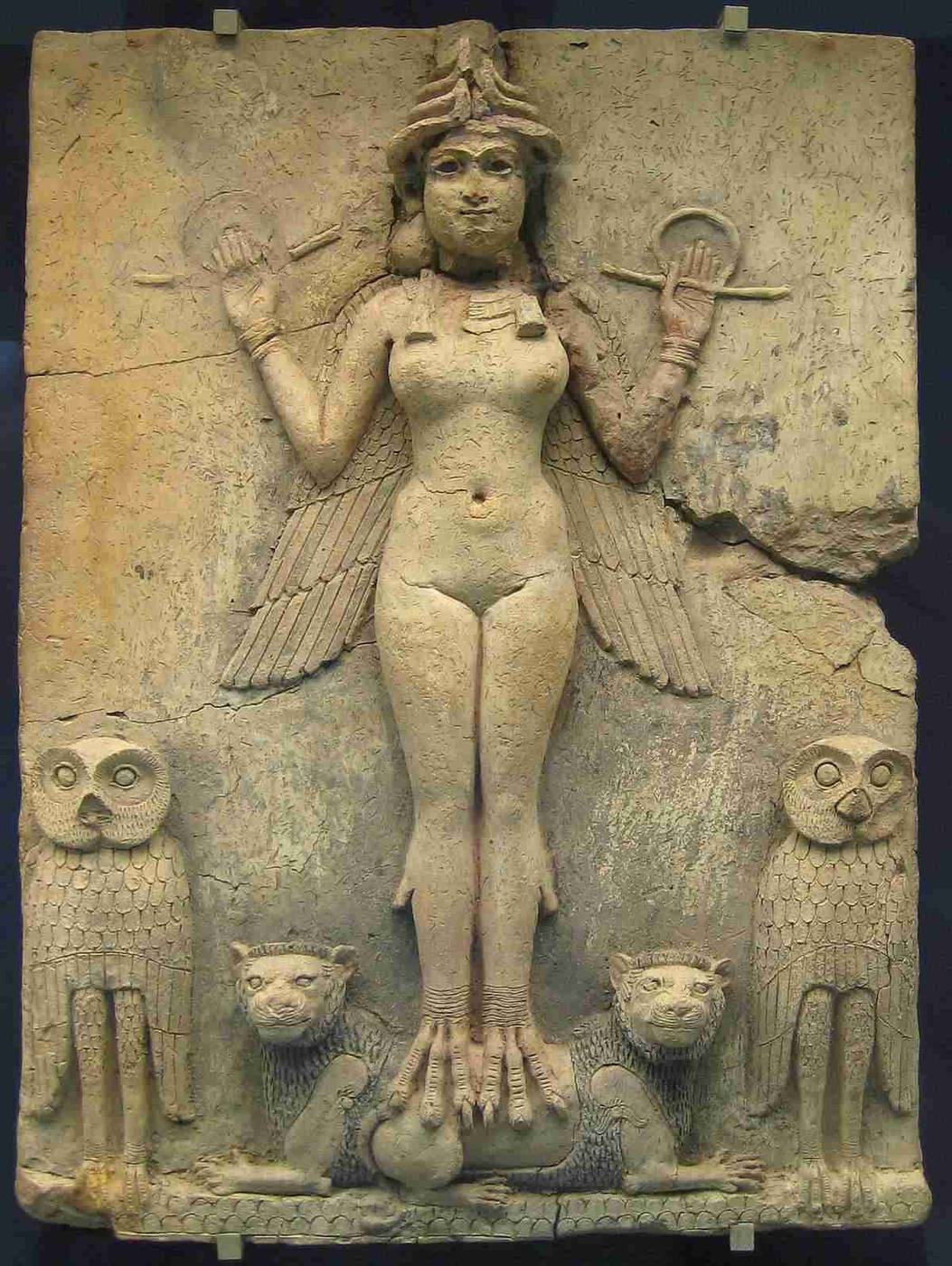
Deep below the streets of Sumer, past an outer gate carved from lapis lazuli, seven iron-bolted doors guard a dark throne hall where no bird flies across the ceiling. Dry clay settles on the lintel, and fine dust coats the hinges while the dead sit on stone benches with brackish cups.
Ereshkigal rules that hall in ancient Mesopotamia. Her Sumerian name means Lady of the Great Earth, and in Babylon she governed Irkalla, the land of no return. She holds the heavy gravity that strips away every borrowed crown and stays with raw weight until it is witnessed. Her seven bolted gates, her dust throne and the two clay mourners map a way to meet loss without armor.
How layers fall away below the ground
We treat weight and darkness as mistakes to fix right away. Old traditions saw them as chambers where borrowed shells come off.
In The Visionary Window, Amit Goswami describes how consciousness steps down into denser levels. As it descends, it wraps itself in layers of separation until solid matter hides the light behind it. In Physics of the Soul, he traces the reverse path. When outer form loosens, consciousness drops its hold on solid earth first, then water, fire and air, until clear awareness remains.
Anne Tucker, in Speak the Language of Angels, looks at that same shedding through a word she calls divestiture. She explains that divestiture means to undress or strip away ornament, rank and earthly belonging. What stands bare after that stripping is what endures.
Ereshkigal waits at the bottom of that descent, where every outer badge drops to the stone floor.
The sister who stayed behind the bolt
This is the story stamped into Sumerian clay in the Descent of Inanna and carried on tablets in Babylon.
Ereshkigal lived in Kur, the great below, drinking brackish water and eating clay beside the dead. Up above, her younger sister Inanna ruled the sky of Uruk. One day Inanna set her ear to the dark earth. She put on her crown, her beads, her breastplate, her gold ring, her lapis rod and cord and her royal robe. She walked down to the gate of lapis lazuli and struck the door.
Neti, the chief gatekeeper, went inside to tell the queen who stood outside. Ereshkigal slapped her thigh and bit her lip with wrath. She gave one order. Bolt the seven gates of Irkalla. Open them one at a time, and at each door strip one piece of gear from her skin.
At the first gate, Neti lifted the crown from Inanna's head. She asked why, and he answered that the ways of Irkalla are exact. At the second gate he took her beads. At the third he took her breastplate, at the fourth her ring, at the fifth her rod and cord, and at the sixth her robe. At the seventh gate he pulled away her last cloth until the sky queen stood naked and bent low in the dust.
Inside the hall, Ereshkigal and the seven judges of the dead fixed the eyes of death upon Inanna and spoke one word of wrath. Inanna fell dead and hung upon a peg in the wall.
Three days passed without mercy. Inanna's servant Ninshubur beat the drum and begged the sky gods for help, yet Enlil and Nanna refused. Only Enki in freshwater Eridu listened. He scraped dirt from under his fingernails and shaped two tiny beings, the kurgarra and the galatur, neither man nor woman. He placed the food of life and water of life in their hands and sent them slipping like flies under the bolted doors.
They found Ereshkigal groaning alone as if in birth pain. She cried out, oh my belly, and they cried beside her, oh my belly. She groaned, oh my back, and they echoed back, oh my back. They brought no sword and gave no lecture. They stayed in the dust and shared her weight.
Moved that anyone stood inside her sorrow without fleeing, Ereshkigal asked what gift they wanted. They pointed to the corpse on the peg. She handed it over. They sprinkled the water of life and held out the food of life, and Inanna rose breathing again.
When the war god refused to stand
A second tablet from Amarna and Sultantepe shows another face of Ereshkigal's court.
The sky gods held a banquet and sent word down to Kur. Ereshkigal could not climb to heaven, so she sent Namtar for her share. Every god stood in respect except Nergal, lord of war and plague.
Ereshkigal demanded that heaven send him down to her court. Nergal packed a wooden chair and brought fourteen demons at his back, following Enki's warning to refuse the bread, water, chair and foot bowl of the dead.
He resisted every offer inside Kur for six days. On the seventh day he gave in and lay beside Ereshkigal for six nights, then slipped back up the stairs before dawn.
Ereshkigal woke to an empty bed and roared until the walls shook. Send him back, she warned heaven, or I will throw open the doors and let the dead eat the living. Nergal stormed back down through all seven gates, pulled her from the throne by her hair and drew his blade. Then she wept and offered him the crown beside her. Nergal lowered the sword, wiped her tears and sat as king of Irkalla.
Empty throne and shared lament
Look past the clay drama, and two rules of consciousness stand clear.
First, borrowed pride never crosses the seventh door. Inanna walked down loaded with gold and titles, and each gate removed one layer until only bare truth remained.
Second, force locks the gate while shared presence opens the spring. Nergal climbed down with demons and a sword, yet he won his seat only by weeping beside her. Enki's mourners carried no weapons. When they matched Ereshkigal's cry in the dark, the wall gave way.
Session 74 of The Law of One teaches that balanced presence acts like a mirror where another sees itself. Session 81 of those Carla Rueckert transcripts adds that each day holds a small death and rebirth. Pain fought from afar turns to stone, while pain mirrored in silence opens the door.
Gates, dust and the fingernail clay
Each threshold inside Irkalla performs an exact step in stripping away armor.
The seven gates called Ganzir slow the descent so outer roles fall off in order, from crown to skin. Neti holds the bolt without malice, repeating that the ways of the underworld are exact. Clay dust and brackish water fill the room because sweet distraction dries up there. The peg on the wall marks the pause where momentum hangs still before breath returns. And the figures shaped from fingernail dirt carry no pride to defend, so they slip beneath the bolt.
The sky sister and the underworld court
Ereshkigal stands inside a fourfold circuit. Inanna climbs into morning light and gathers crowns, while Ereshkigal waits under the earth where crowns return. Enki sits in sweet water, sending wit and pity down the stair when heaven forgets the dead. Nergal brings heat from outside until fire and dark earth share one bench.
Tom Kenyon and the Hathors map a kindred circuit in his essays on psycho-navigation. An inner stair runs both ways, upward toward light and downward into the underworld to face buried grief and gather lost strength. Yet Kenyon warns that no one should camp in the cave to escape daylight. A bridge must carry what you gathered back into the outer air.
Irkalla in the birth chart
Babylonian skywatchers tracked Venus vanishing below the horizon before rising as the morning star, echoing Inanna's journey to her sister's house. Modern astrology maps Ereshkigal onto Pluto, discovered in 1930, and Black Moon Lilith, the lunar apogee point, alongside ancient Saturn, the Moon and the deep water houses.
Look first to Pluto and the eighth house, where surfaces peel away and loss rearranges old plans. Saturn touching the Moon carries the dust of Irkalla when comfort dries up. Black Moon Lilith marks the sister outside the palace who refuses polite smiles while something hurts below. In the twelfth house, old roles dissolve before sunrise, and the fixed star Algol in Perseus marks the stark gaze that turns pride to stone unless met with a mirror.
Sitting before the seventh bolt
Come to Ereshkigal's gate when grief or stripped truth sits like stone in your chest. Meet her to honor a passage and drop old armor, so frozen weight can move back into circulation.
Sit at dusk on a low cushion or bare floor, with one rough stone and a slice of plain bread on a plate beside you. Walk down seven stone steps in your mind, naming one role or badge of pride left at each door until you sit bare.
Rest your attention in your belly and lower back, where Ereshkigal groaned. Name the heavy weight in five plain words without trying to cheer it up. Echo it back as the kurgarra echoed her cry, and hold that weight for five slow breaths until the grip softens.
When the tension eases, seal the seven doors behind you so Irkalla remains a passage instead of a house you camp in. Stand up slowly, switch on a warm lamp, and eat the bite of plain bread to step back to the table of the living. Set the stone beside your doorway and return to one plain duty in the lit room.
Questions people ask about Ereshkigal
Who is Ereshkigal in Mesopotamian myth?
Ereshkigal is the Sumerian and Babylonian queen of the underworld, called Kur or Irkalla. Her name means Lady of the Great Earth, and she is the elder sister of Inanna and Shamash.
Why did Ereshkigal strip Inanna at the seven gates?
She ordered Neti to remove one emblem at each door so Inanna entered Irkalla without rank or special favor. In the land below, every soul stands equal and bare.
Who rescued Inanna from Ereshkigal's hall?
Enki shaped two small beings called the kurgarra and galatur from dirt under his fingernails. They entered Irkalla, echoed Ereshkigal's groans until she felt witnessed, and received the water of life.
Who was Ereshkigal's husband?
In earlier Sumerian lore she wed Gugalanna, the Bull of Heaven. In the later epic, the war god Nergal descended to Irkalla and ruled beside her.
Where does Ereshkigal appear in a birth chart?
Astrologers link her to Pluto, Saturn, Black Moon Lilith and the eighth and twelfth houses. Those placements mark endings, stripped illusions and the clarity that follows loss.
The queen beneath the floor
Ereshkigal is the weight that strips away false crowns so truth can breathe again.