In a courtyard in Borsippa, a scribe smooths a palm-sized slab of damp Euphrates mud and cuts a marsh reed to a three-sided tip. He presses crisp wedges into the clay, then lays the tablet out in the sun to bake hard. Three thousand winters later, a reader can lift that baked slab and read the price of grain, a temple hymn, or a table of stars.
Standing guard over those clay rooms from Borsippa's temple Ezida to the library of Nineveh was Nabu. He is the Mesopotamian god of scribes, libraries, wisdom and prophecy, the son of Marduk, and the swift twin of Mercury in the twilight sky.
How a mark stops time
We think of memory as something floating inside the head. Physics tells a stranger story.
In The Order of Time, Carlo Rovelli asks why the past leaves traces while the future does not. A crater stays stamped in the moon. A fossil sleeps in rock. A line stays dark on a page. For anything to leave a trace, Rovelli writes, motion must arrest itself and give up heat into what it touches. Even the goose quill of a scribe warms the page slightly as it scratches a word. Without friction and heat, everything would bounce back forever, and nothing would remember anything.
Ancient Babylon had its own name for that moment when breath stops into a mark that lasts. It named it Nabu.
The canal boat to the Chamber of Destinies
Nabu was born to Marduk, king of Babylon, and his queen Sarpanitu. In older Sumerian cities, the craft of grain and writing belonged to the goddess Nisaba. As Babylon and Assyria rose, Nabu inherited her reed and her tablets. His wife was Tashmetu, whose name means She Who Listens.
His main temple stood across the river from Babylon in Borsippa, called Ezida, the True House. His name comes from a Semitic root meaning to call out, announce, or speak clearly.
Every spring at the Akitu festival, Babylon held a rite that looked nothing like war. Nabu did not ride into town behind chariots or spears. Priests lifted his gilded statue onto a barge at Borsippa and floated him peacefully up the canal into Esagila, the house of his father.
Inside the Chamber of Destinies, Nabu sat beside Marduk. He lifted one reed stylus over wet clay. Together they wrote the destiny of the land for the coming twelve months.
Yet Babylon never read that tablet as a blind cage. Far to the north at Nineveh, the Assyrian king Ashurbanipal built a vast library of clay tablets. At the bottom of his tablets, in closing lines called colophons, the king wrote his thanks to Nabu and Tashmetu. He praised them for giving him open ears and sharp eyes to copy ancient records from before the flood, so medicine, law, and star tables would not vanish.
What the river reed encodes
Look past the clay, and two strict laws govern Nabu's house.
First, listening comes before writing. Nabu sits beside Tashmetu, She Who Listens. Writing without listening turns into noise, boasting, or rumor. Listening without writing fades when the speaker leaves the room. When the ear clears the air first and the hand writes what was heard, a thought outlives its speaker.
Second, a mark outlasts a sword, yet a living record never turns to stone. Bronze and iron rust to dust in a few lifetimes. A few wedge marks baked in mud outlive kings, armies, and walls.
Lee Carroll, speaking as Kryon, describes the soul's library in much the same way. In his teachings on the Akashic record, that memory does not sit on a shelf in the sky. It lives inside human DNA as a living record of experience, never as dead pages in a book. In an older age, Kryon says, that record replayed old fear and drama like a tape. When present awareness wakes up and speaks directly to its own record, the record shifts. It begins to yield wisdom instead of old scars.
Maia Nartoomid calls such inner stores Halls of Inscriptions. In her view, true halls of records do not hoard dead relics. They hold living codes across time until guardians arrive with the eyes to read them.
The stylus, the clay and the listening ear
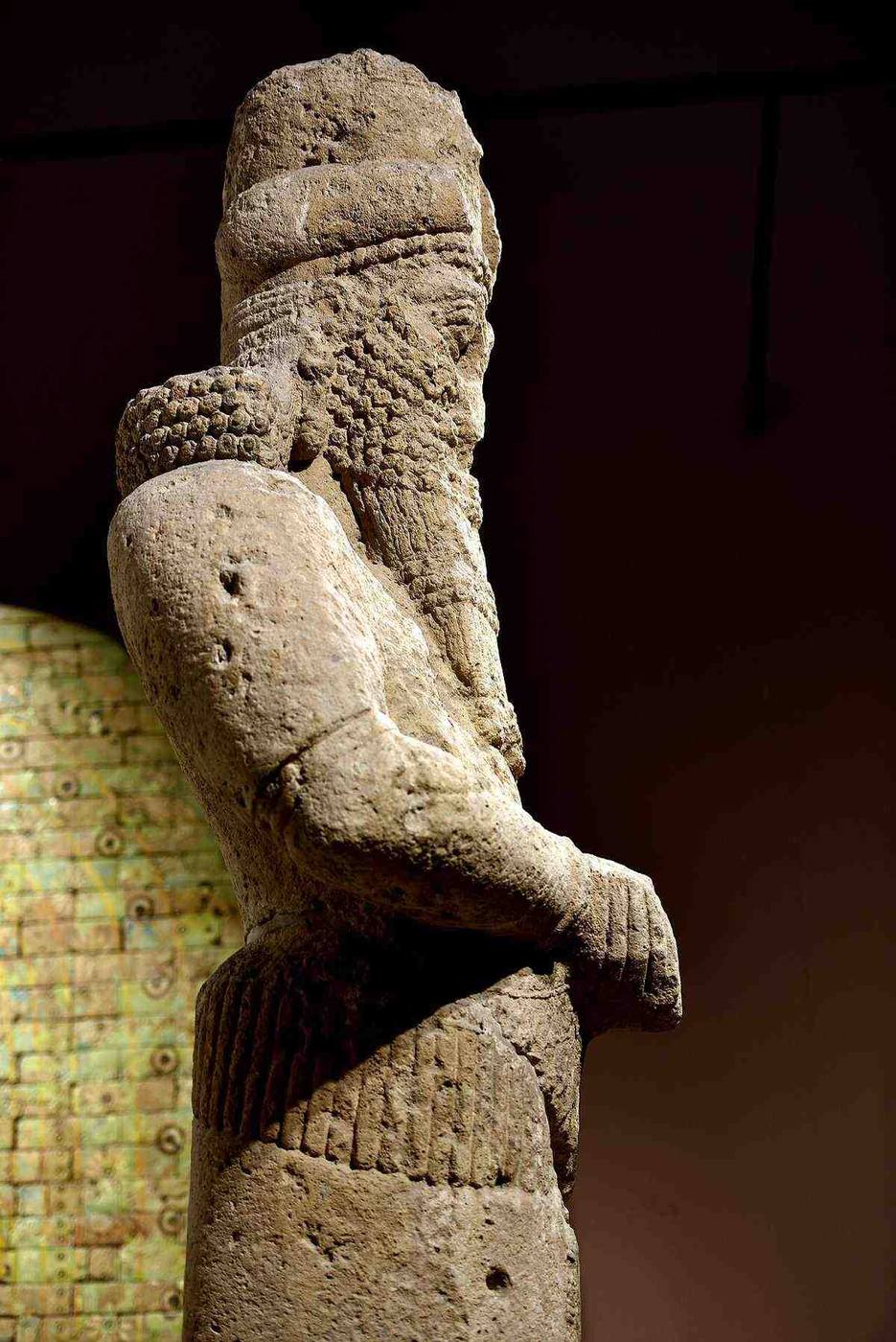
Stand before the stone statue of Nabu from Nimrud, carved in the eighth century BCE, or inspect a stone marker from Babylon. His emblems are spare and plain.
No axe or thunderbolt rests on his altar. Instead, his sign is a triangular wedge, the tip of the qan tuppi river reed, resting beside a flat tablet of clay. Why did a warrior empire lift a piece of marsh grass beside royal crowns? Because a ruler who cannot keep true books loses the kingdom faster than one who loses a battle.
Beside the reed stands Tashmetu, clearing bias out of the room before a line is cut. Beneath Nabu's feet or stamped on his seal crawls the Mushhushshu snake dragon borrowed from his father Marduk. Even a library needs teeth at the gate. Clear records attract those who would forge, erase, or burn them.
Nabu in the sky
Babylonian star priests tracked the swift planet Mercury in twilight and named it Gu-ud, and later Nabu.
Mercury never strays far from the Sun. In a birth chart, Mercury shows how your mind gathers signals, sorts what it hears, and shapes speech or craft.
Notice whether Mercury rises before the Sun or sets after it. Morning Mercury runs ahead into new ground like a scout. Evening Mercury turns back to weigh the receipt and check the footnote.
When Mercury meets Saturn in a chart, Nabu sits in the still library. The mind loves patience, law, code, editing, and proof that holds weight. When Mercury meets Jupiter, the scribe enters his father's house, turning notes into wide books or schools. Modern astrology also watches Mercury meet Uranus, discovered in 1781, when the reed cuts a fresh script that breaks open stale rules.
Watch Mercury retrograde periods too, three times a year, when the planet appears to walk backward across the stars. Those weeks echo the canal trip back to Borsippa. They ask us to check old drafts, mend loose promises, and fix the ledger before signing fresh clay. Look to Gemini, Virgo, and the third, sixth, ninth and tenth houses to see where your desk, your notebooks, and your public voice stand.
Cutting a true line in damp clay
Call on Nabu when thoughts crowd your head, when promises blur, or when skill risks dying because no one wrote it down.
Come on Wednesday, the day of Mercury, or in clear morning light. Clear your table until only a blank notebook, a pen, and a smooth stone paperweight sit before you. Paper recalls wet Euphrates clay pressed smooth, and the stone recalls the courtyard sun that bakes wedges firm.
Begin with Tashmetu's half of the work. Sit without speaking for three minutes. Let mental chatter run dry until you hear the room itself. Ask one true question about what needs to be written or mended today.
Now pick up the pen. Write down what happened, what you owe, or how a craft works, in plain words a stranger could follow. Do not polish it for praise. Press each line onto the page with care, as if cutting wedges into wet clay that must bake in the sun.
When the page rings true, read it aloud once from top to bottom. Hear if any line sounds crooked, and fix it on the spot.
When the last line holds firm, cap the pen and lay it beside the notebook. Shut the cover and set the smooth stone on top of the closed book, as a scribe lays a finished tablet out to dry. Step away from pages and screens for ten minutes so the ink settles without smudging.
Questions people ask about Nabu
Who was Nabu in Babylonian mythology?
Nabu was the Babylonian and Assyrian god of scribes, libraries, wisdom, contracts and prophecy. He was the son of Marduk and Sarpanitu, the husband of Tashmetu, and the lord of Ezida in Borsippa.
Why did Nabu travel by boat during the Akitu festival?
Every spring equinox during Babylon's Akitu festival, priests carried Nabu's statue up the canal from Borsippa to Babylon's Esagila temple. There he sat beside Marduk in the Chamber of Destinies to write the year's fate on fresh clay.
What are Nabu's main symbols?
His chief emblems are the wedge-tipped reed stylus, known as the qan tuppi, and a clay tablet. Often they appear beside the horned dragon Mushhushshu, showing memory guarded by fierce protection.
Which planet belongs to Nabu?
Mesopotamian astronomers linked Nabu to the swift planet Mercury, calling it Gu-ud in their star diaries. Later cultures matched that same role to Thoth in Egypt and Hermes in Greece.
How does Nabu relate to work and astrology today?
In a birth chart, Nabu speaks through Mercury, showing how listening, plain writing, coding, teaching and true records turn daily labor into lasting craft. His pulse sharpens during Mercury transits and retrograde reviews.
The stylus and the seal
Nabu is the keeper of the true mark, the scribe who listens before he cuts a line into clay.
Explore our Career and Vocation reading to see how Mercury, Saturn, and your chart's working houses point toward the craft built to last through your hands.