Along the spring-swollen floodplain of the Euphrates, reed bundles lashed with bitumen held back wild snowmelt and turned raging floodwater into straight irrigation canals for Babylon's barley fields. Without banks and sluice gates, the same river that fed the valley swept huts and granaries into mud.
In Babylon that shaping force bore the name Marduk. Born in the freshwater spring of Eridu with four eyes and four ears, he became the patron god of Babylon, the king of the Mesopotamian sky, and the bright planet Jupiter. His story tells how civic order is drawn out of floodwater, and how a ruler keeps that order from turning to stone.
Canals, wind nets and living order
We tend to think that floodwater and canal walls are enemies. On the river plain, they depend on each other.
Unbanked water drowns the seed and wastes itself in salt marsh, while dry canals without current crack in the sun. Civic order works like a reed dam or a fisherman's net. It does not destroy wild power. It gives scattered energy banks to run between so a city can stand and eat.
Tom Kenyon and the Hathors note that the Western four elements reach back to the Babylonian tablets of the Enuma Elish. Those clay tablets name earth, sea, sky and wind, with Marduk set at the head of the gods. In Kenyon's view, those elements are not dead matter. Each one holds awareness that answers when met with gratitude.
The battle on the salt water
This is the story chanted at the New Year in Babylon, cut into the seven tablets of the Enuma Elish.
Trouble came when the younger gods grew loud in the dark. Old Apsu could not sleep, and he planned to destroy them. Enki, the wise lord of sweet springs, heard the plot first. He put Apsu to sleep with a spell and killed him in his house, then built his own shrine above the deep.
In that house Marduk was born to Enki and Damkina. Four eyes turned in his head, and four ears caught every whisper. Fire leaped from his lips when he spoke. Anu gave the boy four winds to play with, and those winds stirred Tiamat until the salt sea could not rest.
Tiamat woke in fury. She bore eleven monsters, horned serpents and dragons with venom in their veins. She set the rebel Kingu at their head and hung the Tablet of Destinies on his chest.
Enki went out to face her, and turned back pale. Anu went out after him, and turned back shaking. No god in the hall could stand before her roar.
Then Marduk stepped forward. Grant me kingship, he told the council, and whatever I speak will stand. They laid a cloak on the floor. Speak, they said, and let it vanish. He spoke, and the cloth was gone. Speak again, they said, and it returned whole.
He took bow and mace, called the four winds and seven storms, and drove his chariot straight at Tiamat. She opened her jaws to swallow him. Marduk sent the evil wind Imhullu down her throat so her mouth could not shut. Then he loosed one arrow through the gap. It tore her heart, and her life went out. He cast his net over her eleven beasts and took back the Tablet of Destinies.
Marduk split her body down the middle like a dried fish. Half he lifted up to roof the sky, setting bolts to hold the upper waters. Half he stretched below to make the earth. From her weeping eyes he opened the Tigris and Euphrates. Above, he set the stars in twelve months. From Kingu's blood mixed with clay, humankind was shaped to tend the earth.
When the work stood firm, the council built Esagila in Babylon and sang his fifty names.
What the story teaches
Two laws of governance and engineering stand beneath the battle song.
First, order does not erase chaos. It gives wild water banks to run between. Marduk never burned Tiamat to ash. He built sky and earth out of her body, and let her own eyes feed the rivers that kept Babylon alive. Every wall and every calendar month in the city stood inside her captured skin.
Second, a mind that divides without heart falls back into confusion. In her talks on finding balance, Anne Tucker points out that the thinking head breeds chaos whenever it only dissects and separates. Unity enters when awareness drops into the heart. True order gathers parts into one living house without crushing what moves inside them.
The four eyes and the dragon at the gate
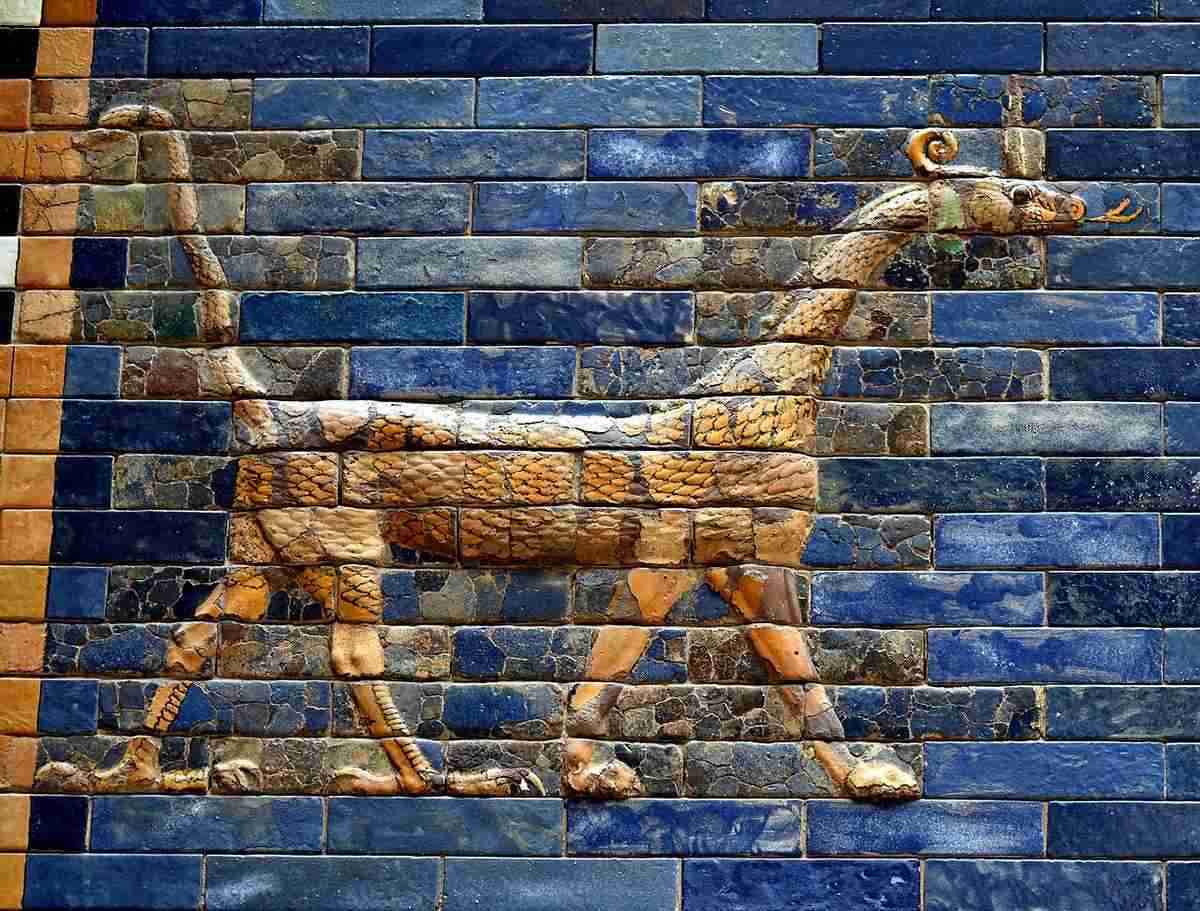
Walk down the Processional Way toward Babylon's Ishtar Gate, and glazed bricks bear one strange beast. It has the horned head of a viper, the front paws of a lion, the back talons of an eagle, and scales down its body. Babylon called it the Mushhushshu, the snake dragon.
It does not lie dead under Marduk's boot. It walks at his heel as a guard.
Wild force is not killed when order arrives. It is given a post at the door. Marduk's own body carries the rest of the instrument. Four eyes look north, south, east and west at once. Four ears hear every corridor before a sword is drawn. Most rulers fail because they stare down one road while three walls behind them crack. Marduk sees the whole field at once, and casts his net before his arrow.
The slap in the spring shrine
One rite in Babylon kept this power from rotting into pride.
Every spring at the Akitu festival, the king of Babylon walked alone into Marduk's shrine at Esagila. A high priest met him there and stripped off his scepter, his ring, his mace and his crown, laying them on a stool before the god.
Then the priest took the king by the ears, forced him to his knees on the stone floor, and struck his cheek.
Only then could the king speak his oath. He declared that he had not sinned against Babylon, had not neglected Esagila, had not forgotten the poor, and had not struck the face of those under his care.
Then the priest struck his cheek again. If tears wet the king's eyes, Marduk blessed the city for another year. If the king stayed dry-eyed, people feared their ruler had grown too hard to lead.
Power that cannot weep when checked has already lost its throne.
Marduk in the sky
Babylonian skywatchers named Marduk in the sky as Jupiter, calling it Mul-Babbar, the White Star, and Nibiru, the Point of Crossing.
Jupiter takes twelve years to walk the zodiac, spending one year in each sign. In a birth chart, Jupiter marks where life asks you to widen your reach, build a house, or gather scattered pieces under one roof.
When Jupiter meets the Sun or Saturn, Marduk builds like an architect. Vision joins law, and large plans take solid shape. When Jupiter meets Mercury, the father joins his scribe son Nabu, pairing strategy with exact words. Modern astrology also watches Jupiter meet Pluto, discovered in 1930, alongside ancient Mars, when the storm chariot rides fast and demands the spring check of Esagila before ambition tramples smaller lives.
Watch Sagittarius, Pisces, and the ninth and tenth houses when birth time is known. Above all, watch your Jupiter return every twelve years and your annual profection year ruled by Jupiter, when stewardship stands in open daylight.
Drawing the twelve canals of order
Meet Marduk when work, money, or plans lie scattered like floodwater and you need walls that hold.
Come at dawn or on Thursday, the day of Jupiter. Sit upright with a sheet of blank paper before you. Name what feels tangled right now. Look around all four sides of the room in your mind, borrowing four eyes and four ears.
Draw a circle on the paper and divide it into twelve rooms, like the months Marduk hung in the sky. Place one duty inside each space where it belongs. Give wild energy a canal to run down. Speak aloud one promise you mean to keep this season.
Now keep the Akitu check of Esagila. Ask yourself one hard question without dodging the answer: where have I grown deaf to smaller voices? Tap your cheek lightly in memory of the spring priest's reminder, fold the twelve-room sheet into your pocket, and step out to mend one neglected duty for someone smaller in your household or town.
Questions people ask about Marduk
Who was Marduk in Babylonian mythology?
Marduk was the chief god of Babylon and king of the Mesopotamian pantheon from the second millennium BCE onward. Born in Eridu to Enki and Damkina, he married Sarpanitu and fathered the scribe god Nabu.
What did Marduk create in the Enuma Elish?
In the Enuma Elish, four-eyed Marduk conquered the sea mother Tiamat with winds and a net. He split her body into sky and earth, opened the Tigris and Euphrates from her eyes, and set the stars into twelve months.
What animal represents Marduk on the Ishtar Gate?
Marduk's creature on the Ishtar Gate is the Mushhushshu, a dragon with a horned viper head, lion forepaws and eagle talons. It walks alive at his heel, showing wild power placed on guard.
Why is Marduk linked to the planet Jupiter?
Babylonian astronomers saw Jupiter's twelve-year stride across the sky as royal governance. They called it Mul-Babbar and Nibiru, linking its orbit to Marduk's calendar and stars.
How does Marduk show up in astrology today?
Marduk lives in natal Jupiter, showing where a person builds order and carries public trust. His pulse grows strongest during twelve-year Jupiter returns and profection years ruled by Sagittarius or Pisces.
The storm and the net
Marduk is the builder of living order, the king who keeps his crown by kneeling once a year.
Explore our Annual Profections reading to see which house of your chart opens for growth and stewardship this year.