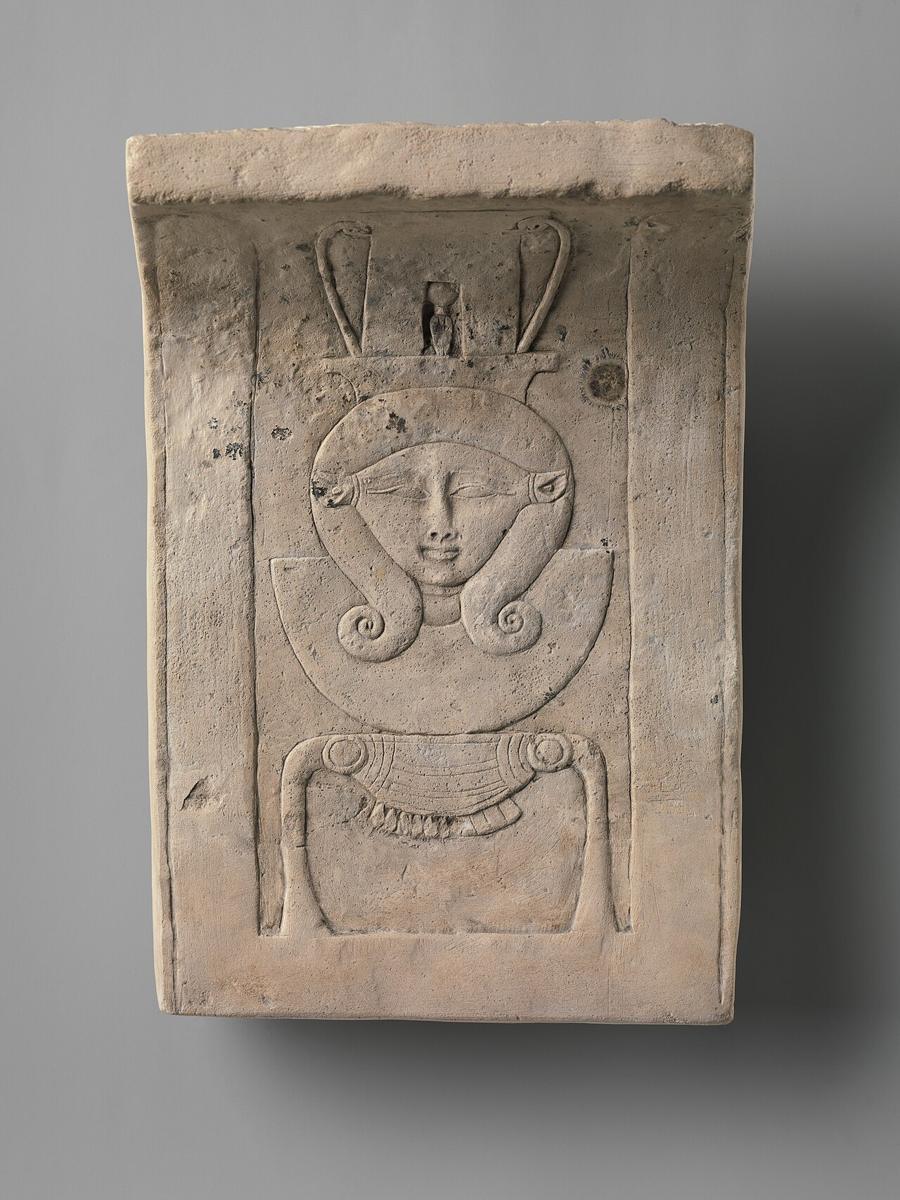
Before the first note sounded in the stone hall at Dendera, twilight pooled along the reeds and heat left the sandstone. Stars came out over Upper Egypt. In a priestess's hand a single rattle moved.
Hathor is the goddess of ancient Egypt called Het-Heru, lady of music, dance, joy, turquoise and the sycamore. Her name means the house of Horus, the sky womb that shelters sight. Where Sekhmet walks out into the desert as blazing fire, Hathor is the same Eye of Ra returning in song. She is the pull that brings back what has gone far. Egypt raised her temple at Dendera and tuned it like an instrument.
How waves meet inside the chest
Strike two bronze bowls in one room. Their rings do not shatter on impact. They cross through the air and build a larger pattern together.
In Meeting the Universe Halfway, the physicist Karen Barad calls this wave behavior diffraction. Water waves, sound waves and light waves all overlap when they meet. They bend around edges and lift higher wherever two crests rise together. Force meets force by collision, yet waves meet waves by resonance.
Egypt placed that same law inside the chest. There are star beings called the Hathors, who say they worked through her temple at Dendera. Now they speak through Tom Kenyon. In Lotus of the Heart they teach that the physical heart throws out a strong field of light and energy. When a person rests attention in the chest with gratitude, a smooth rhythm climbs the vagus nerve into the brain. The brain falls into time with the heart.
In Ecstasy and the Heart they say that attention works like the center of a vortex in the field around the body. Mere thoughts of thanks do nothing to that field. Only felt warmth moves the current, turning the chest into a bell that rings in tune with Earth.
Lee Carroll, who channels Kryon, names the Hathors among the star beings that keep a law of allowance. They wait outside the door until a human opens it from within. Force cannot summon Hathor. Resonance invites her in.
The day the sun lay down
This story was copied on papyrus in the New Kingdom tale of Horus and Set.
The sun god Ra sat alone inside his tent after a bitter quarrel in the divine court. He lay down on his back in the dark and turned his face away from the gods. Without his light, work stopped across heaven and earth. No god dared enter to scold him.
Then Hathor, lady of the southern sycamore, walked through the door with no speech on her tongue. She stood before her father, lifted the hem of her skirt, and danced before the silent king.
Ra looked up from his mat and broke into sudden laughter. He rose from the floor, washed his face, and took his seat once more at the head of the court. Light returned to the land because one laugh cracked a locked door.
The Eye that came home from the south
Egypt told a second tale of her in the temples of the south.
Once the Eye of Ra quarreled with her father and left him. She went as a lioness into Nubia, far up the river, and would not come home. The fields cracked. No one sang. There was no army to send after her. So Ra sent Thoth, in the shape of a small baboon.
He carried no spear. Each night he sat before the lioness and told her a story, and every story was set in the green land she had left. She began to walk north, to hear how they ended. At Philae she stepped into the cold water of the cataract, and her fire went up in steam. Women stood on the banks with wine and rattles. When she came to Dendera, her face was the face of Hathor. Every year after, Egypt kept that homecoming as the Festival of Drunkenness.
What the two tales encode
Read together, these myths state two laws of energy.
First, a closed thing opens to its own note. A wine glass will stand against the hand and shake at a single tone. No god could force the door of Ra, and one laugh opened it. Joy is that tone.
Anne Tucker, who channels Isla, the Mother of Creation, hears the same of the whole Earth. Joy is an unstoppable force, says Isla. It moves over the land and breaks apart what was rigid. It is a new dawn, at the hour when all seemed most fixed.
Second, what has gone far cannot be dragged home. It is called, by something sweeter than the place where it is. Maia Nartoomid, who transmits from Thoth, calls Sekhmet the deliverer of the Eye of Ra and Hathor its receiver and reconciler. The temple city of Hathor, she writes, stood on a mountain in the Sinai that Egypt called Hathormetis.
The temple and its instruments
The temple of Hathor at Dendera still stands, and her face looks out from every side of its pillars. Look again. Each pillar is a sistrum, with the handle below and her face above. The temple is one great rattle, and whoever walks in stands inside the instrument.
Her ears are the broad ears of a cow, set wide to hear every whisper in the pasture. Above her brow rise curved horns cradling the sun disk. The horns build a gentle cradle so solar fire stays warm without scorching what it touches.
In one hand she lifts the sistrum, a bronze rattle strung with sliding metal bars on wire rods. Tom Kenyon notes that priests at Dendera used harps, drums, flutes and sistrums to shift into trance. A sistrum makes a bright hiss like wind through dry reeds. That high ring wakes attention inside stone rooms.
Around her throat hangs the menat, a heavy collar of beads with a flat metal weight along the spine. Dancers shook the menat like a bell, sending vibration straight into the collarbone and heart.
In her other hand she holds a mirror of polished copper. Hathor ruled mirror craft and the turquoise mines of Sinai. Egypt called a mirror ankh, the same word as life.
Outside the wall stands the sycamore fig, her tree at the edge of the desert sand. In tomb art she leans from its green branches to pour water and offer figs to weary souls. Even beside death, the cosmos sets a shaded table.
The eye she healed with milk
Hathor belongs to a clear circuit with Ra and Horus. She is daughter and eye of the sun. She is also the nurse who healed Horus when Set tore out his eyes in the desert.
She found the young hawk-king blind upon the sand. She caught a gazelle and bathed his sockets in warm milk until sight returned. In her own name, Het-Heru, she is the house where Horus lives. An eye must have a house. In the temple that house is stone. In a person it is the chest.
Where Hathor moves in the sky
Egypt placed her beside Sirius at the flood and gave her the golden cow horns of heaven. The Greeks knew her as Aphrodite, and by that road astrologers give her Venus, the planet of beauty, music and love.
In a birth chart, her pulse answers through Venus in Taurus, her pasture of taste and touch. It answers also through Venus in Libra, her hall of symmetry and grace. Look to the Moon beside Venus, where instinct and warmth flow in one stream.
When Venus meets the Sun, purpose warms the heart, just as Ra smiled when Hathor danced. When Venus meets Jupiter, the table overflows like the Festival of Drunkenness. When Venus meets Chiron, the wound is brought to the milk.
How to call Hathor and close the gate
Call on Hathor for love, for joy, and for the return of what has gone far. She cannot be forced. She comes to her own note.
Come at twilight, when noon glare drops off the walls. Or come on Friday, the day of Venus, with music nearby.
Set a bowl of cool water and a small mirror on a table before you. Sit upright and lay one palm flat over the center of your breastbone, directly over the physical heart.
Remember one thing you are glad exists on earth. A tree outside, a voice you love, warm bread or falling rain will work. Wait until your ribs warm beneath your hand.
Now give the chest a voice, as Kenyon teaches in the Dendera work. Hum one smooth note on an open vowel like ah or oh. Let the sound vibrate behind your breastbone until the breath ends. If you have a rattle or bell, shake it beside your shoulder for three breaths, then let the metal fall still.
Then lift the mirror, as she does, and sound the note once more toward the face in it.
When you finish, close the circuit with care. Set the rattle and the mirror down. Drink half the water, and pour the rest at the root of a tree or a plant, for the lady of the sycamore. Speak the name Het-Heru with thanks, and step back into ordinary evening work.
Questions people ask about Hathor
What is Hathor the goddess of in ancient Egypt?
Hathor is the Egyptian goddess of love, joy, music, dance, beauty, fertility and turquoise mining. She is also lady of the sycamore tree who offers cool water and bread to travelers at the desert edge.
What does the name Hathor mean?
Her Egyptian name is Het-Heru, which translates as House of Horus. It marks her as the sky womb and sheltering house that holds the falcon god of vision.
Why is Hathor shown with cow horns and a sun disk?
In Egypt, the cow stood for nourishment, patience and abundance. Her curved horns cradle the sun disk to show solar fire held safely inside loving warmth.
What was the sistrum used for in Hathor temples?
Priests and priestesses shook the bronze sistrum rattle at Dendera to clear stagnant air and enter trance. Its crisp sound helped worshippers tune their attention to the goddess.
How can someone connect with Hathor today?
Connect through music, unhurried thanks felt in the physical heart, and simple beauty such as water, copper or song. Always close by drinking water and giving the rest to something green.
The house of joy
Hathor is the laugh that opens the door, and the house the Eye comes home to.
Explore your Love Horoscope to see how Venus draws affection, beauty and shared delight through your birth chart.