Mist lay flat on the black water of the marsh, and nothing in the reeds could see past the next reed. High above it a falcon hung on the air and did not move a wing. It held both edges of the horizon inside a single glance.
Horus is the falcon god of ancient Egypt, lord of the sky and of kings. His name in Egypt was Heru, the distant one, the one who is above. He wears the head of a falcon or stands as a winged disk above temple doors. Where others fight in the reeds, he rises. His eye was torn out and made whole, and it sees further than before. He is sight itself, the kind that stands above a thing and sees the whole of it. His two eyes, and the one that was healed, are the instrument.
How looking settles the world
A falcon hanging three hundred feet above a marsh sees things a runner in grass will never spot. From grass height, every stalk hides a snake. Every turn looks like a wall. From the air, the whole creek bends into view at once.
Physics has met a stranger rule. In his books The Self-Aware Universe and God Is Not Dead, the physicist Amit Goswami explains what happens when we measure an electron. Before anyone looks, the electron does not sit at one dot in space. It spreads out like a cloud of waves, carrying many possible locations at the same instant.
Then an observer looks with a measuring device. The wide cloud collapses into one sharp point. Goswami calls this the observer effect. Conscious looking turns spread-out possibility into one concrete event.
Egypt drew that mystery with feathers and two eyes. While the eye wanders, the world remains a cloud. When it settles on one mark, the mark becomes real, and the falcon drops.
Eighty years in the marsh and court
This story comes from an ancient papyrus called The Contendings of Horus and Set, alongside temple hymns at Edfu.
After Set murdered Osiris and flung his pieces across the valley, Isis hid her son Horus deep inside the papyrus thickets of Chemmis. Scorpions crept between the stalks while marsh spirits guarded the reeds. Once a scorpion stung the boy near sunset. Thoth stopped the sun boat in midair until poison left his veins.
Horus grew strong in secret until he stepped out before the council of the gods to claim his father's crown. Set laughed and called him a weak boy raised in mud. For eighty years they fought across desert cliffs, river islands and open courts.
They turned into giant hippopotamuses and dived under the Nile to see who could hold his breath the longer. They stood before the sun god and argued while elders shouted from bench to bench. Each time Set tried brute force, Horus answered with craft.
Once Set challenged him to a boat race across the river using ships carved from stone. Set hacked a boulder out of a cliff and pushed it into the Nile, where it sank like lead. Horus felled cedar planks and shaped a light boat. He painted the hull gray with plaster until it looked like granite. His painted boat floated down the water while Set raged on the shore.
Yet the battle turned cruel. In one night fight beneath a dark sky, Set struck Horus across the face and tore out his left eye, the eye of the moon. He shattered that eye into six pieces and scattered them along the bank.
Blind on one side, Horus staggered into the hills. Hathor found him lying against rock. She bathed the torn socket with fresh gazelle milk and woke the fire in his brow. Then Thoth came down with his scribe's reed. He counted the six scattered pieces, found the missing sixty-fourth part that had vanished into mud, and fitted every fraction back into place.
They called the healed eye Wedjat, meaning whole and sound.
At last the gods judged the claim in favor of Horus and placed the crown of Egypt upon his head. But he did not take the throne that day. He walked down into the Duat where Osiris sat in silence. He laid his healed eye in his father's hand so Osiris could see light again inside the dark.
Laws inside the eighty-year trial
Eighty years is long, even for gods. The story measures how long it takes to rise above a fight. It holds two laws.
First, brute force blurs attacker and defender until nobody can tell them apart. While Horus wrestled Set nose to nose in the dirt, neither one held a true throne. Victory came only when Horus built a light vessel painted like stone and rose above Set's weight.
Second, a wounded eye healed becomes stronger than an eye never struck. Horus lost his lunar eye and gained the Wedjat, an eye counted down to the tiniest fraction. Because he knew darkness from inside the wound, he could carry sight down to Osiris without fear.
Watch a river hawk after rain. It never dives into dirty floodwater while mud churns. It circles higher until silt settles and one fish glints below. Then it drops without wasting a wingbeat.
The snare of Set and Horus
Tom Kenyon, who teaches Egyptian High Alchemy, gives the danger of that long fight its Egyptian name. There is an image in which Horus and Set are locked in battle, so fiercely that it is hard to tell one from the other. It is called Set-Horus.
The battle is in the world, Kenyon writes, and it is also within. Inside a person, high aim and base craving pull at the same rope until both drown in noise.
In Kenyon's reading of the myth, Horus breaks free only when Hathor opens his Third Eye with etheric fire. That opening lifts his vibration past the tug of opposites. He becomes the High God Horus, seeing past duality from above instead of trading blows in the mud.
Kenyon also quotes the poet Yeats, warning of the hour when the falcon cannot hear the falconer. The falcon is the high part of awareness meant for open sky. The falconer is the grounded vessel standing on earth. When sky and earth stop listening to each other, circles widen and the center breaks.
The hawk above the capstone
What rises above the fight has work to do. In Maia Nartoomid's A Feeding of the Soul, Thoth names him the Divine Solar Hawk. He is Messenger, Nurturer, Protector and Wayshower.
A friend of hers had dreamed of a young man with a hawk laid over him, and the hawk fed his sister and gave her strength. Thoth read the dream. The woman is Isis as the star of light in the heart. The man is Osiris. The falcon is Hor'Ra feeding the heart with solar grace.
In a companion essay, The Capstone Eye of Horus, Nartoomid turns to the Great Pyramid at Giza. She describes a charge of blue fire rising out of the Vault of Osiris deep beneath the stone and shooting upward into the missing capstone at the summit. There Horus is born and takes flight toward Orion, carrying signals through his eye and upon his wings.
In her own oracle, the Electrikum, the Eye of Horus belongs to Sagittarius, and it is the descending triangle of the star. It goes into matter with its vision uncompromised. There it joins the knowledge of the hand to the knowledge of the spirit.
And he is older than the pyramids. In Session 23 of the Law of One, Ra remembers coming to the skies over Egypt eighteen thousand years ago. The people below already worshiped a hawk-headed sun god, and his name was Horus.
Reading the falcon and the eye
Every emblem carved beside Horus acts like one part of an optical instrument.
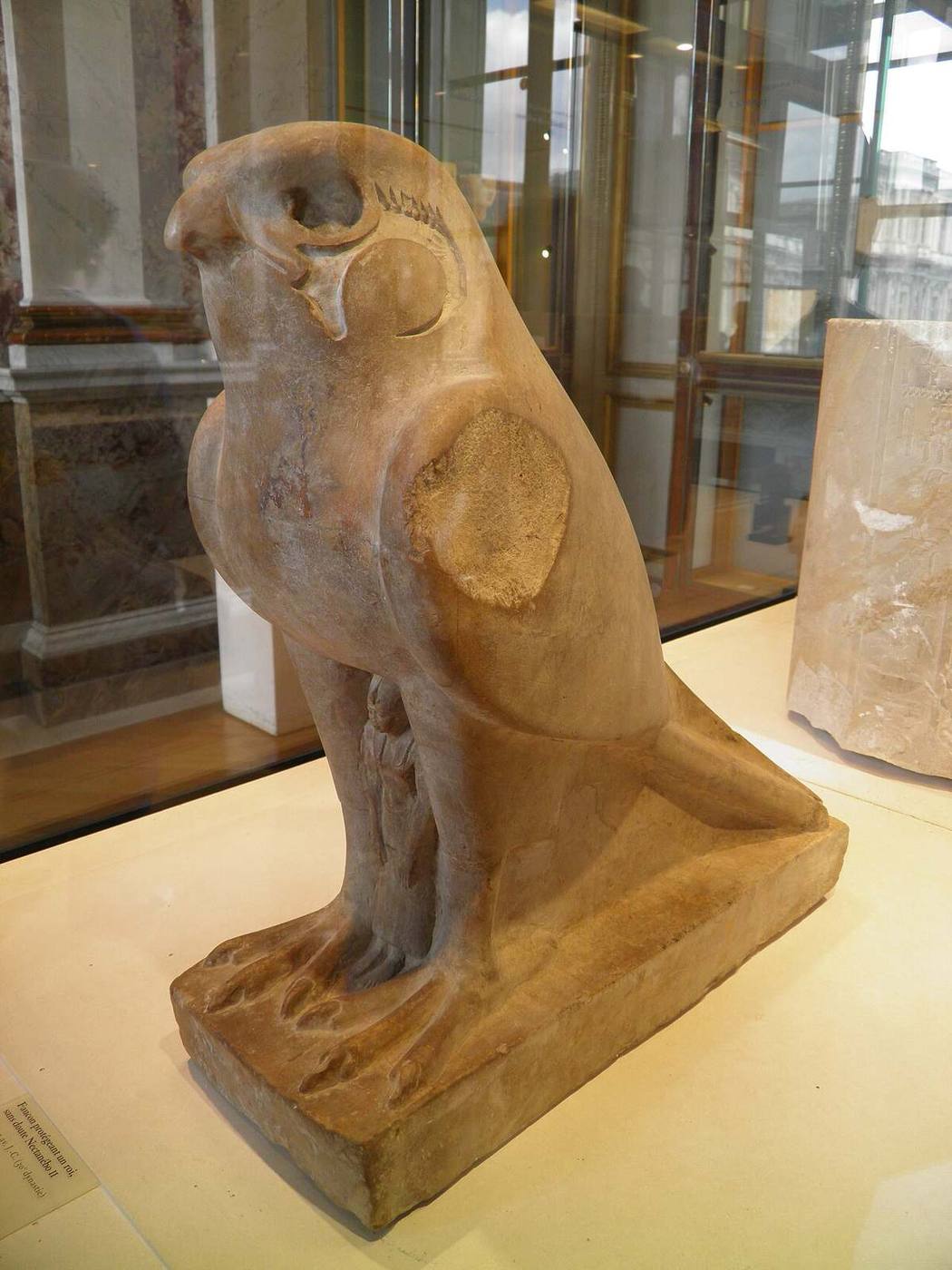
First stands the peregrine falcon itself. In the statue of King Nectanebo II, a tall falcon rises behind the king's back and wraps its wings around his shoulders while his own figure sits small between the claws. The message is plain. True authority is not the mortal sitting in front. It is the sky watcher standing right behind the neck, shielding the spine and reading the horizon.
Second comes the Wedjat, the Eye of Horus with a falcon cheek mark beneath the pupil and a curled tail behind. Egypt used the parts of this eye to write fractions of grain measure. The brow, pupil, iris and tear tracks stood for one half, one fourth, one eighth, one sixteenth, one thirty-second and one sixty-fourth.
Together they make sixty-three parts of sixty-four. The last part is never in the pile, and only Thoth can supply it. The eye itself teaches that human sight on its own stops short by one tiny fraction, and wisdom supplies the grace that makes it whole.
Third are the twin eyes. Egypt called the right eye of Horus the Sun and his left eye the Moon. Sun sight burns away fog and names sharp lines in daylight. Moon sight remembers mercy, reads hidden tides, and senses what aches in the dark.
Fourth is the Winged Sun Disk carved above temple gates across Edfu and Dendera, called Heru-Behdety. Two wide wings stretch out on either side of a solar sphere, guarded by twin cobras. Whoever entered the sanctuary went in beneath it, and left the narrow eye outside.
Finally comes the Double Crown, joining the white cone of Upper Egypt with the red wicker crown of Lower Egypt. Horus does not rule half a country. He holds high plateau and fertile delta inside one ring.
The circuit of sky and soil
Horus stands at the peak of a triangle linking earth, heart and sky.
Osiris gives him root and memory in the dark beneath. Isis gives him shelter inside the marsh and teaches him patience until his wings fill out. Without both parents, the falcon flies wild with nowhere to land.
Hathor, whose name Het-Heru means House of Horus, is his nurse and consort. She pours milk into his torn socket when Set blinds him, softening fierce sky heat with joy and warmth. At Edfu, Horus's falcon boat sailed south each year to meet Hathor coming north from Dendera, uniting clear vision with living beauty.
Thoth stands beside him as witness and restorer of missing math. Even Set belongs to the circuit. He is the stone that proves the painted boat can float.
Where Horus flies in the sky
Egypt gave Horus three of the wandering stars. Mars was Horus the Red, Jupiter was Horus who bounds the Two Lands, and Saturn was Horus, Bull of the Sky. Astrologers now look for him where the Sun and Mars meet. The Sun gives clear purpose and broad light. Mars gives courage, aim and the speed of the strike.
When Sun and Mars join strongly in fire signs like Leo or Sagittarius, Horus wakes early. Leo brings open nerve beneath the crown. Sagittarius brings long aim, lifting the eye past petty fences toward distant mountains and foreign horizons.
If the birth time is known, look to the Midheaven at the top of the chart, and to the Ascendant, where earth meets sky in the east. Horus is Lord of the Two Horizons, Horakhty. The Midheaven shows what your wings build in public daylight. The horizon marks the exact edge where hidden intent enters visible work.
Watch also where Saturn makes a hard aspect to the Sun or Mars, a conjunction, a square or an opposition. That is the eighty years in court. It prunes impatient dives until skill matches ambition and a person earns the crown through real craft.
How to interface with Horus
Call upon Horus when you are too close to a thing to see it, or when you must choose one path out of ten. Do not bring him a rival to crush. That is how Set-Horus is made.
Choose his dawn hour when the sun cracks the eastern line, or noon when shadows shrink beneath your shoes. Step outdoors if possible, or face an open window looking toward wide sky.
Stand tall with both feet hip-width apart and ribs lifted. Let your arms hang loose beside your hips like folded falcon wings. Rest one hand lightly over your sternum and bring one finger to the space between your eyebrows.
Look straight out toward the farthest point on the horizon you can see, whether a rooftop, ridge or cloud line. Do not squint or force your gaze. Hold the whole wide span inside one soft glance for seven full breaths, letting side edges stay clear. This is the falcon hovering above the marsh.
Now narrow your gaze to one small object at a distance, a chimney, tree fork or bright leaf. Ask one clear question about your work or duty aloud. Name the one real step in front of you today, stripped of noise and excuses. Just as Goswami's observer turns wide waves into one event, let scattered plans snap down onto that single mark.
Then touch your brow once, where Hathor opened the eye.
Now land. Let your arms drop, and bring your eyes down from the far line to the ground at your own feet. Lay both palms on wood, on stone or on the earth. Then take the one step before sunset, and tell what you saw to someone who cannot see it yet, as Horus carried the eye to Osiris.
Questions people ask about Horus
Who is Horus in Egyptian mythology?
Horus, called Heru in Egypt, is the falcon-headed sky god of kingship, protection, war and clear vision. Born to Isis and Osiris after Osiris died, he fought Set for eighty years before winning Egypt's throne and restoring sight to his father in the underworld.
What does the Eye of Horus mean?
The Eye of Horus, called the Wedjat, means whole and restored. Set tore out Horus's lunar eye and split it into six fractions totaling sixty-three sixty-fourths. Thoth recovered the missing sixty-fourth and healed the eye, making it an emblem of protection, precision and restored insight.
Why is Horus shown as a falcon?
Egypt honored the peregrine falcon because it flies high above marsh and desert, reads wide terrain in a single sweep, and dives faster than any creature on earth. Its wings behind a king's neck showed sky protection guarding earthly rule.
What is the difference between the Eye of Ra and the Eye of Horus?
The Eye of Ra is the fierce solar power sent outward from the sun, often shown as Sekhmet or Hathor. The Eye of Horus, the Wedjat, is chiefly the healed lunar eye tied to restoration, protection and offering light back to Osiris.
How does Horus appear in an astrology chart?
Horus shows through strong Sun and Mars links, Sagittarius or Leo emphasis, and prominent placements near the Midheaven or eastern horizon. When Saturn touches Sun or Mars, he marks long apprenticeship that turns raw nerve into lasting craft.
The wing and the mark
Horus is the clear falcon eye that rises above mud and anger, heals what was torn, and drops straight onto its true work.
Career and Vocation reads those solar, martial and Midheaven lines in a birth chart to show where high vision meets daily craft and calling.