Each autumn the Nile drew back and left black mud behind it. Out of that dark crust a green blade pushed upward in silence. Nothing on the bank could hurry the barley, and nothing in the heat could kill the seed beneath the dirt.
Osiris is the ancient god Egypt called Asir in its own tongue. They named him Wennefer, the one who remains whole, and Khenti-Amentiu, foremost of those in the west. He is lord of grain, lord of eternity, and king of the Duat beneath the earth. When an old form breaks apart and looks finished, Osiris holds its pattern intact until new life rises through the crack. Egypt raised his pillar every year and sowed his clay beds with barley. The pillar and the seed are the technology, and every person is born with both.
Breakdown as the door to order
Most machines wear down and stop. Set a warm cup inside a cold room, and heat leaks out until cup and air share one flat temperature. Physics calls that flat balance equilibrium. In living things, equilibrium is death.
In his book The Web of Life, the physicist Fritjof Capra explains how living systems stay alive by doing the reverse. Drawing on the scientist Ilya Prigogine, he calls living bodies dissipative structures. A tree, a river whirlpool or a human body keeps its shape only because energy and matter pour through it without pause.
When that flow grows strong enough, the old pattern can no longer hold the strain. It shakes and cracks. At that breaking point, a higher order steps forward out of the ruin.
Earlier still, the Russian thinker Alexander Bogdanov studied how complex systems form and shift. He showed that crisis is the breakdown of an old balance and the birth of a new balance at the same instant. Even a forest floor proves this rule. Capra notes how insects and fungi break dead wood back down into simple nutrients so green plants can drink them back into sunlight.
Egypt read that law in the Nile flood and named it Osiris. A living pattern surrenders its brittle shell and sinks into dark ground. What looks like ruin from above is compost feeding the next stalk from below.
The chest, the tree and the fourteen parts
The priests of Abydos told it, and the Greek Plutarch wrote it down.
Osiris was the firstborn child of Nut the sky and Geb the earth. He arrived on the first of the five hidden days that Thoth won from the moon. He walked among the people as a gentle king. He taught them how to sow barley, press grapes, dig canals and live under law without blood feuds.
His brother Set watched from the dry desert and grew bitter. In secret, Set measured Osiris while he slept. Then he ordered carpenters to build a cedar chest fitted to that exact frame and inlaid with gold.
At a feast with seventy-two allies waiting by the doors, Set brought the chest into the hall. He offered it as a prize to whoever lay inside and filled it to the inch. Guests tried one by one and failed. At last Osiris stepped in and stretched out along the wood.
Before he could sit up, Set and his men slammed the lid shut. They drove bronze nails through the rim and poured hot lead over every seam. They carried the box to the Nile and dropped it into the current.
The river swept it north into the open sea. Waves pushed it ashore at Byblos, where it settled at the foot of a young tamarisk shrub.
Overnight the shrub drank the life inside the wood. It shot upward into a tall tree whose fragrant bark wrapped completely around the chest. The king of Byblos saw that giant trunk, ordered his builders to cut it down, and set the timber upright as the main pillar holding up his palace roof.
Far away in Egypt, Isis cut a lock of her hair and put on linen of mourning. She walked down every canal until children playing by the river told her where the current had gone. She sailed to Byblos, sat beside the palace well, and won the trust of the queen through the scent of her braids.
Inside the hall she asked for the great pillar. She cut away its bark with a blade, anointed the wood with oil, and wrapped the trunk in linen for the king. Then she carried the chest back across the sea to the reed marshes of Egypt.
Isis hid the box deep in the reeds. That night Set rode out hunting by the full moon. He stumbled upon the cedar chest, tore open the lead seal, and cut his brother's body into fourteen pieces. He flung those parts from one end of the valley to the other so no town could hold him whole.
Isis refused to leave him scattered. With her sister Nephthys flying beside her in hawk wings, she searched the swamps and sandbanks. They gathered thirteen pieces on a reed mat and shaped the fourteenth out of clay and river water.
Together with Anubis, master of linen and balm, Isis wrapped the limbs tight in cloth and breathed warmth across his lips. Osiris woke. His chest lifted, his eyes opened, and he joined with Isis long enough to plant the seed of Horus inside her womb.
Yet he did not stay above ground to fight Set for his old crown. He stepped down through the western gate into the Duat. There he took his seat upon a square throne above the dark waters. From below, he judged every soul crossing the threshold and pushed every green shoot upward into spring light.
What the scattering encodes
Two truths stand inside it.
First, breaking a vessel scatters only the casing. The chest held Osiris's outer measure, and Set's knife divided his limbs across fourteen provinces. Yet every piece still kept the scent that drew the tamarisk upward and led Isis through the marsh. Cut a willow branch into twigs, press each twig into wet dirt, and each one grows roots and leaves. The pattern lives inside every piece, never inside one bone alone.
Second, what is cut down rules from the root. Set kept the loud palace and the desert wind. Osiris moved under the floor of the world, where the roots of every field and the memory of every soul cross his path.
The root sleeps under winter frost while the dry stalk snaps in the gale. When spring returns, the root sends sap straight back into light, and the wind has nothing left to break.
The world pillar and the stars of Orion
Maia Nartoomid writes Akashic teachings she receives through her mentor Thoth. In her essay The Shamir and the Tree of Osiris, she reads the Byblos tree as a cosmic map. She calls the tamarisk trunk holding Osiris the Tree of Life and the World Pillar, the Axis Mundi around which the sky appears to turn. She links Osiris straight to Orion, calling the Tree of Osiris the Tree of Orion.
In her teaching, light codes that shape the human template pour into our region from Orion. Osiris stands at that root like a gyroscope keeping balance between star fields above and matter below. Even the chest wrapped in living bark mirrors the later linen mummy. Both form a single pillar soaking up divine word from deep waters while holding up the sky.
Nartoomid also describes a flash called the Shamir, sent from the Eye of Ra, which bores into the center of that Tree so Osiris wakes inside DNA. Beneath the Great Pyramid of Giza, which she calls the Temple of the Risen One, she places the Vault of Osiris as an earthly mirror of Orion's Vault.
In her essay The Orion Nebula Trapezium, she calls the Eye of Osiris the light of central intelligence shining from Orion through every star. And the music of this arising, she teaches, is our own heartbeat and our own breath. Place is changed by awareness, Thoth tells her, and no one walks there.
Reading the bronze figure
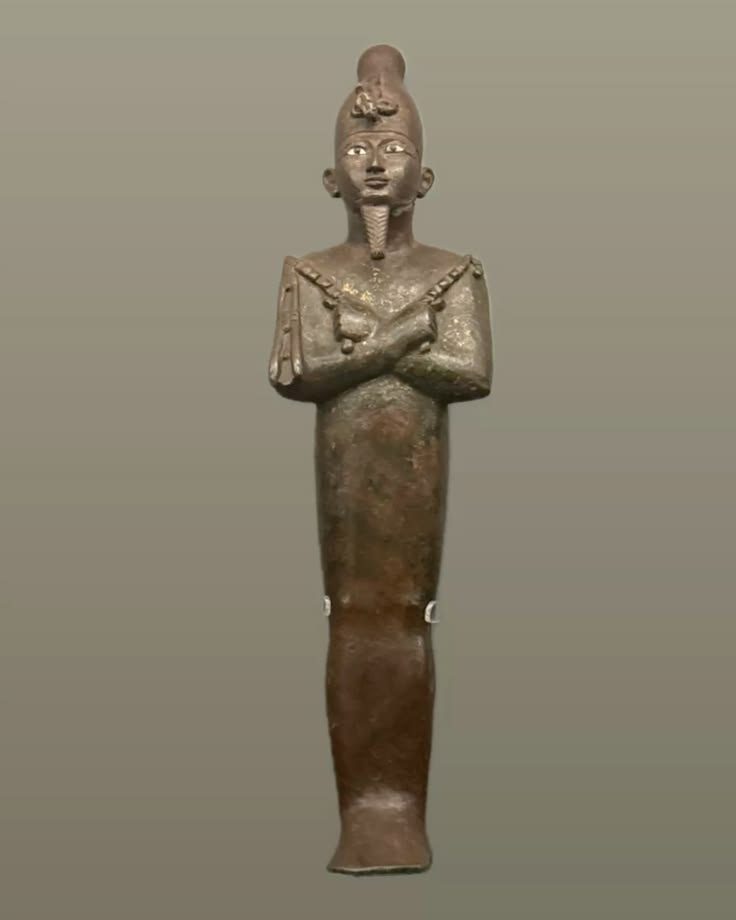
Stand before a bronze statue of Osiris from late Egypt. Every detail from foot to crown belongs to one instrument.
His skin is green or black. Green is chlorophyll waking inside soil, the first sprout pushing through silt after months under water. Black is khem, the dark mud of the Nile valley that gave Egypt its name. Neither color means rot. Both mean hidden life storing strength out of sight.
His legs and chest are wrapped tight in linen, with arms crossed over his ribs. Set scattered his force across fourteen regions. The cloth pulls that force back inside one frame so nothing leaks away. Stillness builds pressure inside a seed coat before the husk splits.
In his hands rest the crook and the flail. The shepherd's crook hooks behind a straying lamb to guide it back onto the path. The flail beats barley heads on stone until dry chaff blows away and whole grain drops into the basket. Renewal needs both tools at once: patient gathering and sharp sorting between living seed and dead husk.
On his head rises the tall Atef crown of Upper Egypt, framed on each side by an ostrich feather of truth. Osiris never rules the underworld as a bitter judge. Truth stands beside both ears and balances every word.
Beneath his throne, or carved beside him in temple reliefs, stands the Djed, a stout pillar topped by four crossbars. Egypt called the Djed the backbone of Osiris. Every year as the flood dropped, priests and king pulled ropes together to haul a wooden Djed pillar upright from flat ground into a vertical line.
Tom Kenyon, who channels the Hathors and teaches Egyptian High Alchemy, names the Djed as the energetic channel running along the human spine. Through that channel rises sekhem, the life force born in the solar plexus. When sekhem moves up the Djed into the brain centers, perception opens beyond ordinary limits.
Kenyon writes that initiates worked with the Ka, the subtle twin of the body, and the Ba, the celestial soul above the crown. When the Ka grew refined enough, it ignited in golden fire. Egypt called that luminous body the Sahu, an eternal vessel no longer undone by death, echoing Osiris rising in the Resurrection Chamber at Dendera.
Even common homes kept a clay frame shaped like Osiris. Families packed it with dark earth, pressed barley seeds inside, watered it in silence, and watched green shoots rise straight out of the god's form. The image did not just mourn a dead king. It showed how stillness turns heavy mud into living food.
The circuit beneath the sun
Osiris never works alone. He sits at the bottom turn of a fourfold circuit that keeps sky and soil moving.
Isis and Nephthys stand at his head and foot like two wings around one center. Isis gathers what belongs to life and breathes form back together. Nephthys watches over twilight and grief, guarding the unseen edge until mourning finishes its work. Without both sisters, the scattered pieces stay lost in the reeds.
Anubis kneels beside the linen wrapping, keeping the threshold clear so change turns into preservation instead of chaos. Horus stands in daylight as the falcon heir who answers Set on the plain and lowers his healed eye into the dark so his father can see again.
And at midnight there is Ra. Each evening the sun sinks in the west, boards the night boat, and sails through twelve dark hours beneath the earth. At the middle hour of night, Ra and Osiris meet in the Duat and share one body for a single breath.
Ra gives his fire to the seed. Osiris gives the tired sun its rest. Without Ra, Osiris would stay cold mud forever. Without Osiris, Ra would burn out his light and never wake at dawn.
Where Osiris moves in the sky
Egypt saw Osiris in Orion, which it called Sah. When Orion climbed above the eastern sand before a summer dawn, ahead of Sirius, the star of Isis, the Nile rose. When the water drew back, green covered the fields. In their night sky, Osiris and Isis walked one track together just as they stood beside the river.
Modern astrologers look for Osiris where a chart joins Pluto and Saturn. Pluto strips away surface shells, clears out false pride, and tests what survives inside the dark vault. Saturn builds the Djed pillar, giving bare bone, spine and winter patience so renewal grows deep roots instead of flashing once and fading.
Watch the eighth and twelfth houses of a birth chart, and watch Scorpio and Capricorn. Scorpio knows Set's knife, the turn that breaks shallow calm and sends life down to its seed. Capricorn builds the upright pillar after storm, patient as grain under earth waiting for spring.
Look also when a slow progression touches the bottom angle of a chart, the IC, or meets Pluto by aspect. Outer titles often fall silent during those years. Beneath that outer silence, Osiris is laying down a truer backbone that no later season can shake loose.
How to interface with Osiris
Interface with Osiris when an old form has broken and its seed must go into the ground. He does not bring back the shell, and he does not skip the winter. His craft works only with what lives beneath the dirt.
Choose his hour at dusk as light leaves the floor, or in late autumn when leaves drop back to soil. Best of all is a clear night when Orion climbs above the eastern horizon.
Set one small clay dish on bare earth or a wood table. Fill it with damp earth and press a handful of whole barley seeds or lentils below the surface. Set a glass of plain water beside the dish.
Sit upright on a hard chair or floor mat with your spine lifted like the Djed pillar. Cross both forearms lightly over your chest, left palm on right shoulder and right palm on left shoulder, matching the still posture of the bronze statue. Breathe slow and deep into your belly until outer chatter drops away.
Notice where your days feel scattered into fourteen pieces. Do not chase those pieces across the room. Feel the vertical line running from the base of your spine up through the crown of your head, just as Kenyon maps the Djed rising toward the Ba point above the skull. Rest your attention inside that column and let stray thoughts drift back to center on their own.
Picture one barley seed resting in black river mud. Nothing pulls it from above. Warmth enters from underneath, and a green tip cracks the coat only when its hour arrives. Spoon a little water onto your planted dish and name one vow you intend to keep upright through the dark months ahead.
Then lower the pillar. Uncross your arms and press both palms flat against cool stone, wood floor or dark garden soil. Bring your attention down the spine to the soles of both feet. Drink the water remaining in the glass, stand up slowly, and rinse your hands under cold tap water before turning back to ordinary tasks. Leave the dish where morning sun reaches it and watch the green blades rise in their own time.
Questions people ask about Osiris
Who is Osiris in Egyptian mythology?
Osiris, called Asir and Wennefer in Egypt, is the god of the underworld, resurrection, grain and cosmic renewal. First honored as a fertility and royal figure at Busiris and Abydos, he became ruler and judge of the Duat after surviving betrayal and dismemberment.
Why is Osiris shown with green or black skin?
Green shows living chlorophyll, sprouting barley and spring sap rising out of dark earth. Black mirrors khem, the fertile silt left along the Nile banks after the annual flood. Both colors honor hidden life gathering force before breaking above ground.
What does the Djed pillar mean?
The Djed is a four-barred column showing the backbone of Osiris and the World Pillar holding sky and earth in line. In Egyptian alchemy it maps the spinal channel through which life force climbs toward higher awareness, and priests hauled it upright each year to mark stability restored.
How is Osiris linked to Orion?
Ancient Egyptian sky lore paired Orion, named Sah, with Sirius, the star of Isis. When they rose before dawn, the Nile flood began. Modern esoteric teachers like Maia Nartoomid also connect Osiris to Orion as a cosmic balance point and seed pattern for renewal.
What do the crook and flail of Osiris represent?
The shepherd's crook stands for patient care that draws straying parts back into one fold. The flail separates ripe grain from dry chaff. Together they show that true renewal joins gentle guidance with clear sorting.
The seed and the spine
Osiris is the upright pillar hidden inside dark soil, keeping every scattered piece of life whole until its new shoot breaks into dawn.
Secondary Progressions follows those slow turns across a birth chart, showing when an outer season ends underground and when the next green blade begins to rise.