There was one stone. Dark water lay around it on every side, and it was the only thing that stood still. Its name was the Benben. Upon that stone a light broke, and it was morning, and there had never been a morning before.
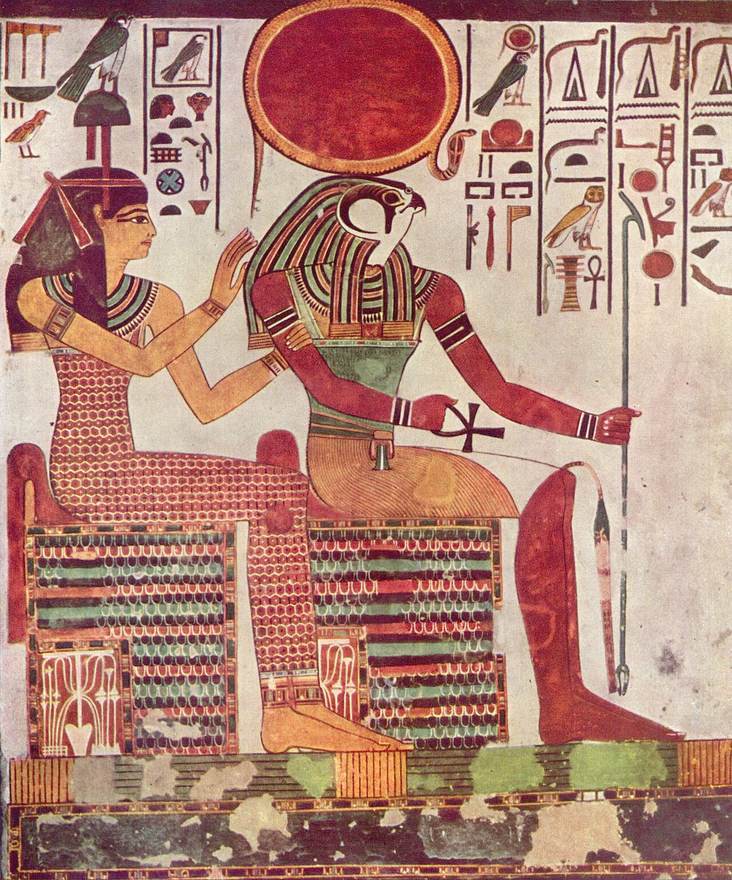
Ra is the sun god of ancient Egypt, known at Heliopolis as Atum-Ra and Ra-Horakhty, Horus of the Two Horizons. He rolls the scarab dawn as Khepri. He blazes as the noon disk Ra. He bends into sunset as the elder Atum. Every breath of life on earth runs inside his circuit across day and night. He is the light that goes down into the dark every night and is not put out. The disk, the two boats and the twelve hours are the instrument that shows how.
How sunlight feeds living order
Everything left to itself cools down and scatters. A hot stone drops its warmth into night air. A tower of sand slides back to flat ground.
In his book Helgoland, the physicist Carlo Rovelli writes that life on Earth works against that drift. Life unfolds by drinking the low entropy that pours down in sunlight. Every leaf traps solar photons to build sugar and wood. Every heartbeat burns that trapped sunlight and returns warmth to the sky.
In The Order of Time, Rovelli adds a deeper surprise. In the basic equations of motion, past and future look identical. The arrow of time appears only where heat and energy flow. Without a hot sun pouring light onto a cooler world, clocks would lose their beat and grass would never lift a blade.
Egypt named that engine Ra.
Twelve hours through the dark river
This story comes from the Amduat and the Book of Gates, painted inside royal tombs at Thebes.
Out of Nun the abyss, Ra spoke himself into being atop the Benben stone. From his breath and moisture came Shu the air and Tefnut the dew, who later bore earth and sky. Ra ruled over gods and mortals together for age upon age, until he grew old.
Once, in his great age, Ra grew weary of rebellion and withdrew to his tent in silence. Hathor walked in, danced with laughter and music, and stirred the old sun back into life. Later still, Isis molded clay with a drop of his spit to form a viper on his morning road. When its venom burned him and no god could draw it out, Ra gave her his hidden name, heart to heart, and through her it came to Horus.
Each morning Ra stepped onto the Mandjet, the Morning Barque. He shone like a beetle rolling a ball of light over eastern sand. By noon he rode high above the valley as a falcon wearing the blazing disk ringed by a cobra. Toward evening he leaned west as old Atum, and the sky goddess Nut swallowed his light into her dark mouth.
On the western rim Ra left the Morning Barque and stepped aboard the Mesektet, the Night Barque. His outer rays dimmed so he could enter the Duat, the river winding through twelve guarded gates beneath the earth.
Gate after gate groaned open as Thoth measured the course. Isis stood on deck speaking words of power.
At midnight, in the lowest vault of the Duat, Ra came to the body of Osiris lying silent in his shrine. For one breath the king above and the king below were one soul with two faces. Ra gave him fire. Osiris gave the weary sun his stillness.
And in the next hour, the seventh, the water thickened into mud and stopped the boat. Out of that black water coiled Apep, the serpent called Apophis by the Greeks, waiting to swallow the sun and end time itself.
No one on that deck turned back. Set stood at the prow and drove his spear between the eyes of Apep. Isis raised her voice to bind the coils while Ma'at held the rudder straight. The boat slid free across the sandbank.
Then the eastern mountain cracked open. Scarab claws pushed the disk clear of horizon mud, and Ra stepped back into the Morning Barque as Khepri, newborn and blinding.
Laws inside the twelve night gates
The road of the boat was drawn on the walls hour by hour, because it was meant to be followed. Two laws rule it.
First, no flame can shine at noon forever without sinking into night. In Egypt, even the creator sun had to lay down his blinding crown, pass through Nut's dark womb, and rest beside Osiris before rising again. Any power that refuses rest burns through its fuel and cracks.
Second, resistance grows thickest right in the middle of the dark passage, never at noon. Apep attacks in the seventh hour when water slows to mud and morning seems farthest away. Light survives that hour through three allies working together on one deck. Clear truth holds the helm, fierce focus guards the bow, and measured speech cuts through dark water.
Watch the tide at its lowest, or the seed under frost. The darkest hour is the bend where the river turns back toward dawn.
The Ra tone and the Law of One
Behind the disk there is a tone.
Maia Nartoomid asked Thoth whether the Eye of Ra might also be called the Eye of Osiris. It is so, he answered, for Ra was never a being. Ra is a function of the living stars. The One sounds it, and every star house passes it on. Osiris bore it too. In the vault at midnight one tone met itself.
The voice in the Law of One calls itself Ra, and it speaks as many who have become one. In the first session it gives the whole teaching in a sentence. Everything that lives, and everything that was made, belongs to one original thought. There is no material in it, the voice says. We are thoughts that dance.
They came to Egypt, they say, eleven thousand years ago, to teach that one thing. They describe building the Great Pyramid by thought-form as an initiation and healing chamber tuned to the Earth grid. Later, during the eighteenth dynasty, a young pharaoh dropped his birth name Amun and took the name Akhenaten in honor of Aten, the single solar disk. Ra notes that Akhenaten caught that unity spark directly, yet his reform faded after his death because priests and crowds drifted back to outward power. The stone disk in the sky was only a reminder. Unity lives inside awareness itself.
The inner sun and the serpent of chaos
The Hathors, through Tom Kenyon, bring that sun down into the human body.
In his message The Inner Sun, Kenyon explains that the solar plexus behind the sternum is a ball of etheric fire tied directly to the sun of our solar system. When solar storms and plasma streams quicken overhead, the inner sun answers inside the body.
Kenyon names two fires working at that center. Jathara Agni fuels ordinary digestion. Bhuta Agni feeds mitochondria inside cells, clears dense obscurations, and drives life force upward along the spine. What it drives upward comes to rest at the brow, and that is why a cobra stands on the disk of Ra.
Then Kenyon points to a carving of Ra with Ma'at standing right behind his shoulder. Ma'at literally has Ra's back, Kenyon writes. Without her feather of measure and feminine stillness, raw solar fire turns harsh and destructive.
In his glossary of High Alchemy, Kenyon also names two other figures from Ra's night road. Nut is the night sky who swallows the sun at dusk so solar force can surrender into lunar dark and heal before dawn. Apophis is the sine wave of duality, the endless rise and fall of highs and lows that hypnotizes attention until the alchemist sees through the ripple to the light underneath.
Reading the disk and the twin boats
The signs carved around Ra are the parts of one engine.
First is the Benben, the tapered pyramid stone set atop obelisks and temple roofs. Gold leaf coated its tip so the first beam of sunrise struck that point while the valley below still lay in shadow. It marks the first spot where formless potential touches earth.
Second is the solar disk circled by a rearing cobra. The sphere holds radiant heat. The cobra guards its edge, so that no power leaves unseen.
Third are the three daily faces: Khepri the scarab at dawn, Ra the falcon at noon, and Atum the elder ram-headed figure at sunset. The scarab rolls a ball of earth across sand just as hidden effort pushes a fresh day into view. Noon holds full height without apology. Dusk bows willingly toward sleep.
Fourth are the two river barques, Mandjet for day and Mesektet for night. Daylight belongs to building, speech and open work. Night belongs to shedding excess heat, navigating dreams and holding firm when water slows.
Fifth is the Great Cat of Heliopolis seated beneath the persea tree. In Spell 17 of the Book of the Dead, Ra takes the form of a spotted tom-cat holding a flint knife. He pins Apep's head beneath his paw and cuts the serpent before sunrise. The great boat needs the small knife. The serpent is cut every morning, before the sun can rise.
The crew upon the deck
Ra never sails alone. A whole circle keeps his boat from capsizing between dusk and dawn.
Ma'at stands beside him because light without proportion burns crops instead of ripening grain. Egypt said the gods themselves feed on Ma'at, eating truth each morning to stay alive.
Thoth stands behind the bow calculating hours and currents so the boat knows which gate comes next. Set guards the prow, lending raw nerve when Apep rises out of black mud. Isis kneels beside the rail, turning raw flame into healing speech when venom or fatigue strikes.
Nut arches overhead as the dark vessel that holds the sun safely through sleep. Osiris waits at midnight in the deep vault so day's gold can touch earth's root. Each figure keeps solar pride from locking into tyranny.
Where Ra burns in the sky
In astrology, Ra is the Sun itself, the single star around which every planet turns. The Moon changes sign every two or three days. The Sun stays about a month in each, and gives the chart its center.
The Sun rules Leo. But the whole road of the boat is drawn in the four angles of a chart, if the birth time is known. The eastern Ascendant is Khepri breaking above sand. The overhead Midheaven is Ra at full height. The western Descendant is Atum stepping into the night boat. The bottom IC is the midnight hour beneath the feet where sun meets Osiris.
Every year, the moving Sun returns to the exact degree and minute where it stood at your birth. Astrologers cast a Solar Return chart for that instant. That annual turn marks a fresh dawn of Khepri, setting the tone, trials and primary light for the twelve months ahead.
Look closely at aspects touching your natal Sun. Sun with Saturn gives lasting structure like an obelisk catching first light. Sun with Jupiter widens generosity and reach. Sun with Pluto strips away borrowed crowns so light burns from bedrock instead of applause.
How to interface with Ra
Turn to Ra when sight has grown dim, when the fire runs low, or when a new year begins. Do not ask him for a noon that never ends. Ra himself boards the Night Barque every evening.
Choose his hour at dawn as the sky turns pale gold, or at solar noon when light stands overhead. Face the east in the morning, or the Sun's side of the sky at midday, with your eyes lowered from the disk.
Stand or sit upright with ribs open and palms resting face up on your thighs. Bring attention to the spot just below your sternum where Kenyon locates the Inner Sun. Do not strain to picture flashing sparks. Simply feel a warm sphere of gold gathering behind your breastbone.
Breathe in for four counts and feel that inner sun brighten. Breathe out for four counts and send simple gratitude to the sun above and the earth beneath your shoes. As Kenyon notes in his Inner Sun teaching, genuine appreciation feeds Bhuta Agni without force.
Trace the three gates of the day in your mind. Name one thing you are pushing into light like Khepri at dawn. Name one act of clear duty you hold at noon. Name one burden you plan to lay down at dusk when Nut receives the disk.
If distraction or doubt hisses like Apophis, do not wrestle the noise. Picture the spotted cat beneath the tree cutting that stray thought away with one calm breath.
Then bring the boat to the western shore. Lay both palms over the solar plexus, and let your hands sink until they rest on wood, stone or soil. Breathe out until the heat lies low and still behind the navel. When the Sun goes down that evening, put out one lamp and sit a while in the dark. Nut has the fire now, and she gives it back.
Questions people ask about Ra
Who is Ra in Egyptian mythology?
Ra is the Egyptian creator and sun god who rose out of the dark waters of Nun atop the Benben stone. Sailing across sky by day and through twelve underworld gates by night, he governs light, kingship, warmth and the daily renewal of time.
What are the three forms of Ra?
Egypt honored Ra in three faces across each day: Khepri the scarab beetle at dawn, Ra the falcon-headed solar disk at high noon, and Atum the elder figure sinking into dusk. Together they map birth, peak strength and graceful surrender.
Why did Ra fight Apep every night?
Apep, also called Apophis, is the serpent of chaos waiting in the seventh hour of night to swallow the solar barque. The daily battle taught Egypt that order and light are never won once forever. They are renewed every night through courage, truth and measure.
How is Ra connected to the Law of One?
In the Law of One sessions channeled by Carla Rueckert, Don Elkins and Jim McCarty, a group consciousness named Ra states that all creation belongs to one original thought. They describe sharing unity philosophy in Egypt, building the Great Pyramid as an initiation instrument, and inspiring Akhenaten's devotion to the solar disk Aten.
How does Ra connect to astrology and the Solar Return?
Ra is the Sun in a birth chart, and the Sun rules the sign Leo. Each year when the transiting Sun reaches its exact natal degree, a Solar Return chart maps the fresh twelve-month cycle of purpose, vitality and outward direction.
The barque and the dawn
Ra is the tireless flame that crosses noon without pride and walks through midnight without fear, returning every morning to light the stone.
Solar Return maps that annual return of the Sun to its natal degree, showing where fresh light breaks in the year ahead and where old heat asks to rest.